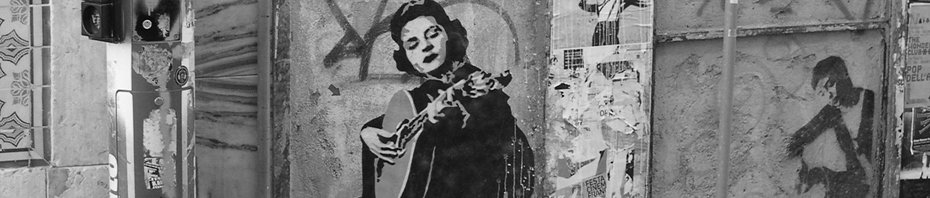
In my previous post, I presented an interpretation of Amália’s ‘Lágrima’ based on a move from what I called the studium of the song text to the punctum of the anguished performance. In a more recent version of ‘Lágrima’ by Jorge Fernando and Argentina Santos there is an even clearer example of such a move. Following a verse sung movingly but not dramatically by Fernando, a studium is set up of melancholic meditation on hurt and loss (fado’s bedrock, we might say). The entry of Argentina Santos’s vocal into this studium shatters (cuts) the ‘stillness’ of the preceding moments. Through her vocalizing, from the anguished cry of ‘se considero’ to the almost whispered final ‘uma lágrima’, Santos creates these puncta via stark contrasts with the surrounding song text. Fernando’s verse and the oboe/cello part create a ‘safe’ space of sadness. Santos’s voice, in its urgency and extremity, destroys this place and reminds us of the ‘real’ pain at the heart of the lyric. This echoes the contrast implicit in the verse structure where a fragmented line is offset against a developed line, the former containing the fetishized object (the immediate thought, the attempt, however doomed, at freedom from language), the latter the interpreted (Symbolic) meaning of the thought.
The fact that Fernando and Santos take ownership of ‘Lágrima’ in the way they do is important in terms of thinking about the fado ‘family tree’, a term which can be understood to relate both to the varieties of fado derived from the basic core of fado corrido, fado mouraria and fado menor, and to the symbolic lineage of fado performers through the years. In this case there is the association of Argentina Santos with a school of singers contemporaneous with Amália Rodrigues – though it should be noted that Santos, like many of her contemporaries, did not tend to be as adventurous as Rodrigues with the material she chose to sing, sticking to a far more ‘traditional’ repertoire. Jorge Fernando was a guitarist for Amália Rodrigues during the final part of her career before going on to release albums made up of his own material alongside work by other fadistas and to produce and play on Mariza’s first album, also contributing three songs to it (‘Chuva’, ‘Terra d’Água’ and ‘Oxalá’). Fernando, who also had a career as a pop singer-songwriter, played a major role in Ana Moura’s career as arranger, producer and songwriter. Like Paulo de Carvalho, Fernando acts as a bridge both between the old generation and the new and between pop and fado.
Prior to the Fernando/Santos recording of ‘Lágrima’, the song had appeared on other fado albums of the 1990s. Dulce Pontes recorded a version on Lágrimas (1993), an album that highlighted the sense of fusion that would come to determine much of novo fado. Emphasizing the notion of a ‘family tree’, Pontes prominently placed a genealogy on the album cover that stated: ‘Father – Zeca [José] Afonso; Mother – Amália Rodrigues; Grandparent – Portuguese folklore; Cousins – Bulgarian folklore, Arabic music’. The instrumentation on the album consisted of the classic fado accompaniment (viola, guitarra) but, with the addition of vocoder, Fairlight synthesizer, electric guitar, piano and orchestra, this was a clear departure from fado norms. The song selection was evidence that, with the passing of time, the strands of folk and fado that had seemed so antithetical to each other in the post-revolutionary era could now be brought together in a useful synthesis: half of the album’s songs were ones associated with Amália Rodrigues, the other half with José Afonso. The mixture proved successful and the album has remained a constant seller nationally and internationally since its release in late 1993, judging by its perennial availability in European record shops such as Fnac, Valentim de Carvalho, and HMV.
The appeal of Pontes’s voice seems to lie in its clarity and consistency and she has adopted a register that sits easily within a range of western popular musical styles, as is noticeable on her 2003 collaboration with Ennio Morricone, Focus, where she provides vocals in Portuguese, English, Spanish and Italian to the familiar tunes of various Morricone soundtracks. As a consequence her music is arguably less subcultural than that of, say, Argentina Santos, a difference that can be read into Pontes’s rendition of ‘Lágrima’ on the 1993 album. This track, along with a version of Amália’s ‘Estranha Forma de Vida’, were recorded live in the studio, presumably to catch the feel of an ‘authentic’ fado performance. Yet, without the ‘grain’ and anguish that Amália and Santos bring to their renditions, the song emerges as ‘merely’ beautiful, somehow missing the cathartic elements of the older fadistas’ versions. In Lacanian terms, there is less a fencing-off of the Thing than an unwillingness to go anywhere close to it; in Barthesian terms, there is an excess of pheno-song and a lack of geno-song, a studium with no punctum. The traumatic potential of ‘Lágrima’ is here elided in a move that maintains the performance firmly within the Symbolic Order, a kind of sanitized mourning that is also to be found ten years later in the song ‘Amália por Amor’ on Focus.
 Mísia, for her part, chose to revisit the song on her 2001 album Ritual, having already recorded a version for her second album in 1993. Where the earlier version, like Pontes’s from the same year, was fairly understated, the second presentation of the song utilized a style not dissimilar to that of Argentina Santos, stressing extremities of vocalization and putting particular emphasis on the key lyrical points discussed earlier. Mário Jorge Torres, in his liner notes to the CD, suggested this ‘new intensity and intentionality’ was due to the song’s inclusion in what was clearly a project inspired by the recent death of Amália. The musical arrangements and guitarra accompaniment are provided by Carlos Gonçalves, who had been Amália’s composer and accompanist during the last stage of her career and had composed the music to ‘Lágrima’. Like Jorge Fernando, Gonçalves here becomes a bridge between the old and new worlds of fado, providing new compositions for Mísia, such as that for ‘Xaile de Silêncio’, a poem sent to Mísia on the occasion of Amália’s death.
In addition to these tracks, Amália is referenced by the inclusion of two songs that seek to extend the late singer’s legacy through the addition of new elements. ‘Mistério Lunar’ is a modern poem put to music written by the famous guitarrista Armandinho that Amália had sung with different words as ‘Fado Mayer’ in the 1950s. ‘Vivendo sem Mim’ is a poem written by Rodrigues, published in Versos but not recorded by her; here, it is put to music by Mário Pacheco and performed by Mísia and the pianist Christian Boissel in a move designed to evoke the way Amália rehearsed with Alain Oulman at the piano. By thus adding words to an ‘Amália’ tune and music to Amália’s words, Mísia suggests the ways in which this dialogic ‘ritual’ might proceed. The ritual extended beyond the song texts to the recording process too, with the use of valve microphones and single takes to emulate recording practices of the 1940s and 1950s.
(This montage of three versions of the song reaffirms my feelings about the power of the original, although I guess the poster feels differently about this than I do.)
 A glance through the part of Amália’s
  It was Amália’s simultaneous ability to court these poets while remaining free from the persecutions of the Estado Novo that came to infuriate many people and that still divides opinion on the singer now. For her critics, Amália’s political naivety smacked too much of the populism peddled by Salazar himself; this was hardly helped by the fact that fado and Amália had become synonymous and that, as fado now became tarred through association with the old regime, so, many felt, should its foremost proponent. This, allied to the sheer excitement of the new forms of music springing up in the wake of the canto de intervenção movement and imported Anglo-American rock music, helped to push fado out of the spotlight in the early days of democracy. Yet fado did not go away and neither did Amália, though her career took a definite downward turn within Portugal for a few years. It was during this period that Carlos do Carmo emerged as the new lantern bearer of fado. Less politically naive than Amália, Carmo brought a commitment to the ideas of the Revolution together with love, deep knowledge and experience of fado gained from his mother, the famous fadista Lucília do Carmo, and from the fado house he inherited from his father. Carmo worked frequently with the poet José Carlos Ary dos Santos and attempted, like Rodrigues and Afonso before him, to bridge the music of the city with that of the countryside. His most notable achievements in this respect were the albums Um Homem na Cidade (1977) and Um Homem no Pais (1983), built upon Santos’s lyrics.
 When Amália did return it was in triumph, performing to packed houses and initiating a new series of recordings which, though they would often veer towards the gimmicky, nonetheless paved the way for her powerful albums of self-written material at the beginning of the 1980s. It is perhaps worth considering Geoffrey O’Brien’s discussion of the return of Burt Bacharach in the 1990s when considering both Amália’s post-Revolution comeback and her audience’s willingness to re-embrace her. The songwriting process that Bacharach and his colleagues symbolize is comparable to the creative process of fado canção, which can be seen as the driving force behind the musical period covered in Fado and the Place of Longing. Like Rodrigues’s ‘classic’ period, Bacharach’s period was one of professionals – a Hollywood-style division of labour – as opposed to the singer-songwriter style that would come to dominate afterwards; O’Brien describes the process as ‘a combination of perfectionism and commercialism’. Eduardo Sucena’s
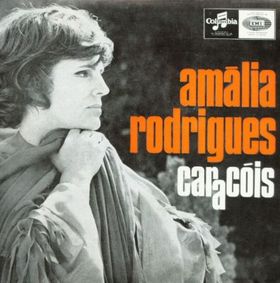
 It is at this same point that fado took on the responsibility of being the professional, ‘official’ Portuguese music of loss (or, as several fadologists would seem to prefer, the music of Portuguese loss, which is saying a rather different thing). Salazar’s policies undoubtedly exacerbated this process of fencing-off but did not create it. As with the emergence of rock ’n’ roll in the United States, there are a number of issues to consider when determining why fado canção emerged when it did and why Amália Rodrigues became its paradigmatic performer, ranging from changes in the law (here, the Novo Estado policies were crucially determinant but previously extant copyright laws should not be forgotten, affecting as they do the role of the artist in the period of mass mediation); migration to the cities; changes in recording and media technology; shifts in the high/low divide in the arts.
 Her biographical details resound with references to poverty, to the Mouraria, to singing on the streets while selling fruit, to being discovered in the fado houses and wooed into the world of professional performance and recording, and, ultimately, to living her life in a fog of saudade and permanent unhappiness which no amount of success or fame could shift. The extent to which the development of this persona was deliberate or accidental seems to matter less than the place she came to occupy in the Portuguese imagination.
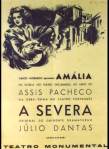 By the time Amália took on the role of Maria Severa in a 1955 Lisbon production of Júlio Dantas’s play, she had already surpassed that early fadista in terms of myth and prominence, due mainly to the success she had achieved internationally. While fado had hardly been unknown outside Portugal previously, it had never reached the level of exposure given it by Amália. Now an international star, she found herself being offered ever increasing opportunities, from performances worldwide to cinema roles nationally and in France. She had also demonstrated a strong desire to explore beyond the limits of traditional fado. It had become increasingly popular for fado singers in the 1940s to move away from the rigidly structured verses of the earlier period towards a freer style based on the work of contemporary poets such as Frederico de Brito. In addition to these newer styles of fado canção, Amália recorded other non-fado and folk songs, as well as Spanish flamenco, Mexican rancheras, and French, English and Italian versions of Portuguese songs (most famously ‘Coimbra’, released in an Italian version under the same title and refashioned as ‘Avril au Portugal’ and ‘April in Portugal’ elsewhere). This explorative aspect of Amália’s approach to her music encouraged musicians and songwriters to approach her with new ideas and led to collaborations that were to have an enormous impact on the direction fado would take.
 On the musical side it is generally agreed, and was frequently admitted by Amália herself, that it was the collaboration with the pianist and composer Alain Oulman which brought about the most far-reaching revolution in her fado style. What Oulman brought to Amália’s work was an ability to break free of established fado styles though a sophisticated musical language, while maintaining a strong link with the essential elements that kept the music recognizable as fado. Amália would rehearse with Oulman at the piano and he would occasionally accompany her on her recordings alongside the time-honoured guitarra and viola. Oulman’s arrangements allowed a greater variety of poetic styles to be utilized for fado lyrics, a development first brought to the public’s attention on the 1962 album Asas Fechadas, popularly known as Busto after the bust of Amália which adorned the cover.
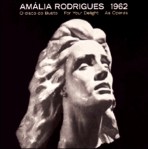 Of the nine tracks on the album seven have music written by Oulman. The lyrics are provided by Rodrigues herself (the famous ‘Estranha Forma de Vida’) and by the poets Luís de Macedo, Pedro Homem de Melo and, mostly, David Mourão-Ferreira, whose 1960 collection À Guitarra e à Viola had been dedicated to Amália and contained the verses for ‘Aves Agoirentas’ ‘Madrugada de Alfama’, ‘Maria Lisboa’ and the political fado ‘Abandono’, all included on Busto. Rodrigues and Oulman also collaborated on the work of less contemporary poets; 1965 saw the release of the EP ‘Amália Canta Camões’ and the album Fado Português, the former containing three adaptations of Portugal’s national poet, the latter harbouring one of the Camões pieces, as well as a cantiga de amigo credited to the medieval troubadour Mendinho, and the title song based on José Régio’s poem, alongside work by Mourão-Ferreira, Homem de Melo and Macedo.
 If the impossibility of dealing with loss comprehensively has led to a sense of a ‘task’ to be achieved, then it is perhaps no surprise to find the term ‘memory work’ increasingly used in contemporary cultural theory. And if one method of going about this work is to employ a ritualistic, or repetitive, process for ‘listing’ loss, then it is worthwhile considering an example of just such memory work, from what I call the ‘I remember’ school of writers inspired by Joe Brainard’s book of the same title. I Remember was first published in 1975 and consisted of a series of entries, all beginning with the words ‘I remember’, in which Brainard recollected moments from his past, some of them highly individual and others doubtless shared by an enormous number of his contemporaries. To take a typical trio of consecutive entries:
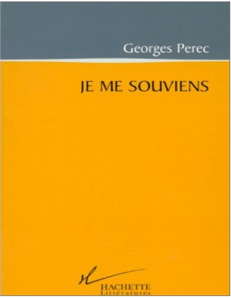 That is not to say, however, that such memory work is necessarily translatable to other cultural contexts. Although Brainard’s book was translated into French by Marie Chaix, the French ‘version’ of I Remember which found most success and which has itself come to be regarded as a classic of the genre, is Georges Perec’s Je me souviens (1978). Perec reduces the autobiographical elements of Brainard’s work to a certain extent, although these are still a prominent feature of his version alongside a higher proportion of memories likely to be shared with others. In producing a more pronounced cultural bias to the book, Perec is forced away from literal translation and towards the creation of a new work steeped in the resonance of the French imaginary. Perec’s intention was to seek out, via his own recollection, moments of memory that could be ‘deconsecrated’ and returned to their ‘collectivity’; speaking about the book he claimed, ‘what came out most clearly for me was that I wasn’t the only one to be remembering. It’s a book I might call “sympathetic”, I mean that it’s in sympathy with its readers, that readers are perfectly at home in it.’
 The fact that Perec’s work increased the ratio of culturally shared to personal memories from Brainard’s original was recognized in 1986 by the British writer Gilbert Adair when he decided to publish his own version of the ‘I remember’ template in his book Myths & Memories. The book was devised partly as a homage to two French writers he admired, Roland Barthes and Georges Perec, and partly as an attempt to apply the techniques of Barthes’s Mythologies and Perec’s Je me souviens to a British context. In Adair’s opinion, Perec’s version of Brainard’s work was distinct enough to warrant its own ‘translation’ but a literal rendering of the French words would be pointless: ‘the fact of its being anchored in a French experience has rendered [Je me souviens] definitively untranslatable; or, rather, translatable only by way of the metamorphosis, the kind of total Anglicizing, which it undergoes here.’ (This observation has an obvious correlation with my earlier discussion of saudade. As for a Portuguese language version of I Remember, the closest parallel would appear to be a Brazilian text entitled Memorando, by Geraldo Mayrink and Fernando Moreira Salles (Sao Paulo: Companhia das Letras, 1993). I have not been able to consult this text to see how it compares with the three versions mentioned here.)
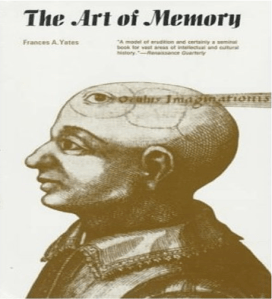 Adair’s conflation of the work of Barthes and Perec serves as an intriguing invitation to think about the concept of mythology alongside that of memory. This has been a strategy taken up by a number of historians in recent years, especially those concerned with memory’s associations with place. Prominent amongst these have been Raphael Samuel and Pierre Nora. Samuel’s ‘theatres of memory’ and Nora’s lieux de mémoire are both influenced by the work of Frances Yates, whose exploration of ‘the art of memory’ relies on notions of myth and place, yet there is an equally important role played by repetition – indeed, memory thought of as an art is born of the desire to be able to repeat. In this sense, it is interesting to note a connection between these historians and the work of the ‘memorians’ of the ‘I remember’ school. In the latter we find a recourse to a ritualistic process (anamnesis, recollection) grounded in the repeated act; this repetition is continued in the representation of memory as these writers follow the unchanging mantra of ‘I remember…’.
 We all experience within us what the Portuguese call ‘saudade’, an inexplicable longing, an unnamed and enigmatic yearning of the soul, and it is this feeling that lives in the realms of imagination and inspiration, and is the breeding ground for the sad song, for the love song. Saudade is the desire to be transported from darkness into light, to be touched by the hand of that which is not of this world … [T]he love song is never simply happy. It must first embrace the potential for pain. Those songs that speak of love, without having within their lines an ache or a sigh, are not love songs at all, but rather hate songs disguised as love songs, and are not to be trusted. These songs deny us our human-ness and our God-given right to be sad, and the airwaves are littered with them. The love song must resonate with the whispers of sorrow and the echoes of grief. The writer who refuses to explore the darker reaches of the heart will never be able to write convincingly about the wonder, magic and joy of love, for just as goodness cannot be trusted unless it has breathed the same air as evil, so within the fabric of the love song, within its melody, its lyric, one must sense an acknowledgement of its capacity for suffering.
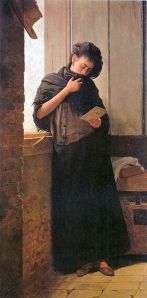 One quality which fado must possess, as all guidebooks will attest, is
  I have been spending a week in Somerset. The right June weather put me in the mind for rambling, and my thoughts turned to the Severn Sea. I went to Glastonbury and Wells, and on to Cheddar, and so to the shore of the Channel at Clevedon, remembering my holiday of fifteen years ago, and too often losing myself in a contrast of the man I was then and what I am now. Beautiful beyond all words of description that nook of oldest England; but that I feared the moist and misty winter climate, I should have chosen some spot below the Mendips for my home and resting-place. Unspeakable the charm to my ear of those old names; exquisite the quiet of those little towns, lost amid tilth and pasture, untouched as yet by the fury of modern life, their ancient sanctuaries guarded, as it were, by noble trees and hedges overrun with flowers. In all England there is no sweeter and more varied prospect than that from the hill of the Holy Thorn at Glastonbury; in all England there is no lovelier musing place than the leafy walk beside the Palace Moat at Wells. As I think of the golden hours I spent there, a passion to which I can give no name takes hold upon me; my heart trembles with an indefinable ecstasy.
 The Place of Longing