When Ricardo Reis writes of having ‘no better knowledge’, he is presumably referring to the consciousness of one’s lot, a topic that can be found in much of Pessoa’s work. Perhaps not unusually for an artist of his time, Pessoa often applies a somewhat patronizing tone to the ‘normal people’ he writes about. The poet is always the suffering artist, who no one else can understand and whose sufferings they, in the simplicity of their everyday lives, cannot imagine. This is true even of the Whitmanesque Álvaro de Campos, in whose celebrations of collectivity there can always be sensed an obverse impossibility for the poet himself to fully participate in the collective. The reflective middle section of Campos’s ‘Maritime Ode’ demonstrates this, as does the concluding section of the poem when the possibilities opened up by the opening hymn are left unrealized. The sense of removal from the world he is describing is more explicit in the later poetry. In the poem that begins ‘At the wheel of the Chevrolet on the road to Sintra’, Campos describes passing a ‘humble’ cabin in the countryside and thinking ‘Life there must be happy, just because it isn’t mine’. In a poem from 1934, he writes of the people in the building across the street from him, ‘They’re happy, because they’re not me’.
Sometimes Pessoa does attempt to place himself among the people: ‘How many, under their de rigueur jackets, / Feel, like me the horror of existence!’ But often people he observes labour under a false consciousness, or, in Pessoan terms, a permanent ‘unconsciousness’. In ‘Almost’ we read of a:
Peddler crying out her wares like an unconscious hymn,
Tiny cogwheel in the clockwork of political economy,
Present or future mother of those who die when Empires crumble,
Your voice reaches me like a summons to nowhere, like the silence of life…
Under Pessoa’s own name, hearing a woman reaper sing:
Ah, to be you while being I!
To have your glad unconsciousness
And be conscious of it!
Or he might try to project his feelings of difference on to others. In ‘Sintra’, he imagines a child gazing back from the window of the cabin at him driving by: ‘Perhaps … I looked (with my borrowed car) like a dream, a magical being come to life’. But he is still the centre of this, ‘the prince of every girl’s heart’. To a certain extent, we might recognize an echo of the tension between Pessoa the poet and the people who populate his poetry in the distinction often drawn between the erudite and the vernacular in fado, and between the fado castiço and the fado canção. We are made aware of this when confronted with the ‘povo’ of ‘Povo Que Lavas no Rio’, in which Amália took on the voicing of Pedro Homem de Melo’s imagination of the people. We might recognize in Homem de Melo’s lyric something of the man in a Ricardo Reis poem who ‘enjoys, uncertainly, / The unreflected life’. The question that subsequently emerges is to what extent a version of witnessing that considers the everyday might help to resolve some of this tension.
 Of all Pessoa’s creations, Ricardo Reis is both the most classically-minded and the one who dwells closest to the classical sense of fate that fado seems to echo. ‘Each man fulfils the destiny he must fulfil’, he writes:
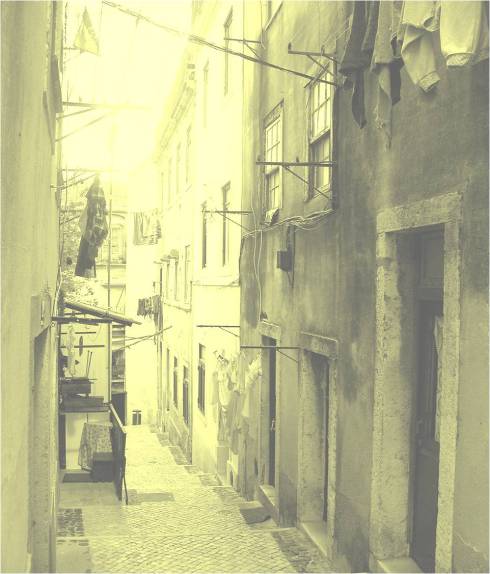 Locating ideology within a framework suggested by Jacques Lacan and Slavoj Žižek may help us here. In doing so, we can posit the Symbolic as the realm of language, or discourse, that attempts to ‘explain’ the Real but which never can, for the Real remains that which cannot be symbolized. Yet that very lack in the Symbolic Order constitutes a gap and it is because of this gap, if we follow Žižek, that ideology is needed. To use a metaphor not entirely inappropriate with Lisbon in mind, if the Symbolic acts as a wall to obscure the Real, a wall that has, however, seen better days and which threatens to allow the chill of the Real in through its cracked tiles and holed plaster (to be punctured, as it were, by the Real), then ideology is the sheen of new plaster needed to fill those fissures. A music more concerned with crumbling, decay, collapse and the wounds that rupture the sheen of everyday ‘bearing up’, a music, moreover, which dwells on melancholy and which actively seeks to remain unreconciled to the world can perhaps be a music closer to challenging ideology than might at first be imagined.
 Can it be that fado operated, then and occasionally still, as a sublimation of the forces operating on the modern subject, that, furthermore, it has occupied the place of what Catherine Belsey calls an ‘abolished particularity’? Belsey suggests that ‘the abolished particularity returns as resistance, marking the speaking being’s loss of the unnameable real, which is still there, but no longer there-for-a-subject. This resistance makes itself felt not only in individual experience, but also as incoherences in the apparent homogeneity of culture itself.’ The stubbornness of fado’s mythemes, the persistence in which the same elements of Lisbonness, shame, jealousy, collapse, flight, the seasons and saudade are endlessly and imaginatively recombined, suggests an unwillingness to move on from the objectification of loss, a process akin to Freud’s definition of melancholy. But what does it mean to be ‘cured’ of this stubbornness except to be taken once more into the Symbolic realm, a realm one might be unwilling to recognize as one’s own?
 The Place of Longing