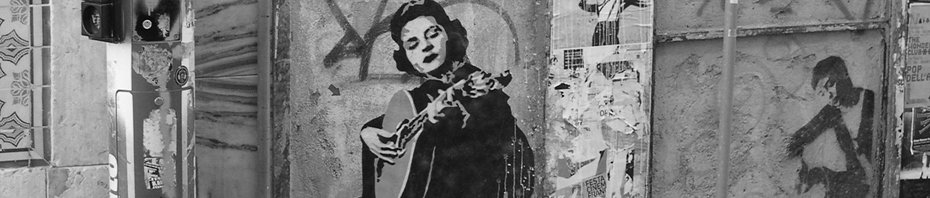
The song ‘Lágrima’, by Amália Rodrigues, appeared on the 1983 album of the same name, which featured lyrics exclusively written by Amália and set to music by the guitarrista Carlos Gonçalves. ‘Lágrima’ was the closing song on the album; its lyrics also appeared, alongside Amália’s other poems, in her book Versos (1997). They are as follows:
Cheia de penas
Cheia de penas me deito
E com mais penas
Com mais penas me levanto
No meu peito
Já me ficou no meu peito
Este jeito
O jeito de te querer tanto
Desespero
Tenho por meu desespero
Dentro de mim
Dentro de mim um castigo
Não te quero
Eu digo que te não quero
E de noite
De noite sonho contigo
Se considero
Que um dia hei-de morrer
No desespero
Que tenho de te não ver
Estendo o meu xaile
Estendo o meu xaile no chão
Estendo o meu xaile
E deixo-me adormecer
Se eu soubesse
Se eu soubesse que morrendo
Tu me havias
Tu me havias de chorar
Uma lágrima
Por uma lágrima tua
Que alegria
Me deixaria matar
[Full of suffering
Full of suffering, I sleep
And with more suffering
With more suffering I awake
In my breast
Already lodged in my breast
Is this habit
The habit of wanting you so
Despair
I have my despair
Inside me
A punishment inside me
I don’t want you
I say that I don’t want you
And at night
At night I dream about you
If I consider
That one day I will die
In the desperation
That I have at not seeing you
I lay out my shawl
I lay out my shawl on the floor
I lay out my shawl
And let myself fall asleep
If I thought
If I thought that when I died
You would have to
You would have to cry
One tear
For one of your tears
How happy
I would be to die]
In considering the song I am drawing upon ideas articulated by Jacques Lacan and Roland Barthes. I do so partly because these thinkers provide a useful vocabulary to attach to the expression of grief and partly because I wish to situate this exemplary instance of fado practice within the wider theories explored in Fado and the Place of Longing. Lacan, in his commitment to Freud, provides a useful connection to theories of mourning, remembering and working-through. Barthes, meanwhile, offers a vocabulary which is explicitly derived from the analysis of texts, whether written, visual or aural. Here, I find his theories of the visual field – as set out in his late work on photography, Camera Lucida – as relevant as his comments on music.
Lacan and Barthes are quite different thinkers with divergent agendas, but their theories do overlap at important places. For Lacan, the ‘Symbolic Order’ is that represented by society’s attempts to impose logic, structure and consistency upon the inconstant qualities of nature, a process carried out first and foremost through language. Against this is posited the ‘Imaginary’, those aspects of the subject’s quest for a wholeness that is always unattainable but always desired, as in the ‘Mirror Stage’ of Lacanian theory. The third Order, the ‘Real’, is that which cannot be symbolised and which exists beyond our attempts to explain inconstant nature. It is inconstant nature itself, which yet, paradoxically, always ‘comes back to the same place’. The Real is that which irrupts into the Symbolic as trauma. Its connections with trauma, jouissance and death distinguish it from the more comforting Imaginary. The writings of Barthes that I invoke here are those in which we find a breaking through of one (often ecstatic) mode of signifying into another, a rupture in the Symbolic Order that calls to mind the momentary glimpse of the Lacanian Real. The major examples of this type of Barthesian thinking are the concepts of plaisir and jouissance, of the geno- and pheno-song, and of the studium and punctum of the photographic image.
What is notable about the lyric of ‘Lágrima’ is what it has to say about absence, how, for the vocal subject, the object of desire does not exist because of a refusal to recognize her. The subject posits a possibility for the object of desire to exist by hypothesizing a recognition – the recognition that the object of desire will mourn her after her passing – that will in turn betray a desire, the object’s hitherto hidden desire for her. The price to be paid for this bringing-into-being of the object and the object’s desire is, here, the subject’s ceasing-to-be, her death.
What are the ‘pleasures’ suggested in the song? Or, rather, what are the signs of what Lacan calls ‘the pleasure of desiring, or, more precisely, the pleasure of experiencing unpleasure’? In short: despair, unrequited love, the dream-world and death. What is moving and pleasurable for the listener are the lengths to which this subject will go to achieve that jouissance which, Lacan reminds us, is in actuality suffering and pain. What is the significance, in Lacanian terms, of the subject’s inability to perceive herself as fully constituted, or rather to see herself as constituted around a lack which she can only resolve by propelling herself from the Imaginary of fantasy to the Real of death? Or should one read the song less literally, as a song about the giving-up of oneself to the Other, an ‘inevitable’ love sacrifice or coming-into-symbolic-being?
We must also ask in what ways we can map musical meaning onto such a reading. One way might be to suggest that the lyrical structure of the poem has encouraged a musical arrangement which, in its simplicity, provides a drive towards emphasis on key lyrical moments. As Barthes notes of classical French mélodie:
What is engaged in these works is, much more than a musical style, a practical reflection (if one may put it like that) on the language; there is a progressive movement from the language to the poem, from the poem to the song and from the song to its performance. Which means that the mélodie has little to do with the history of music and much with the theory of the text.
(Roland Barthes, ‘The Grain of the Voice’, in Image-Music-Text, tr. Stephen Heath (London: Fontana, 1977), p. 186.)
Applying Barthes’s notions of studium and punctum to ‘Lágrima’, we can attempt to sonorize these occularcentic figurations in an attempt to construct a theory of listening. For Barthes the studium is the cultural ‘participat[ion] in the figures, the faces, the gestures, the settings, the actions’, while the punctum is the ‘element which rises from the scene, shoots out of it like an arrow, and pierces me’. In a sonorized version the studium is the song text, the instrumental, vocal and lyrical setting which, within a few short bars, confirms this as a typical fado, albeit of the modernized fado canção style. Into this text are then studded a number of puncta, which can be identified as follows: the first syllable of ‘penas’ in the first line, echoed in the repetitions of the word in the subsequent three lines; the third syllable of ‘desespero’ in the first line of second verse, again echoed; the interplay between ‘considero’ and ‘desespero’ in the third verse. The fourth verse holds back from delivering its punctum, waiting, according to standard fado practice, for the repeat of the final phrase; when it comes (and we can detect in that word’s double meaning an echo of Barthes’s idea that the voice ‘caresses, it grates, it cuts, it comes’), it does so as the entire phrase ‘que alegria me deixaria matar’.
I interpret these as puncta mainly due to the vocal articulation audible at these points and with the repetitive pathos to be found in these over-emphasized words and phrases. While it would be possible to describe this process merely as a succession of emphases without resorting to Barthesian terms, I am keen to anticipate a connection established in Fado and the Place of Longing between photography and fado texts, as I believe that one of the things these texts do is to participate in an ongoing ‘study’ of Lisbon(ness), in which the oft-hymned city is both studium and stadium of memory. While ‘Lágrima’ makes no explicit mention of place, I would maintain that it inherits a sense of place due to numerous connections between text and context; the ‘Lisbonness’ of fado, here, is a state of mind which may be cognitively inaccurate but is mythologically and psychologically vital.
Barthes has saved us the effort, to some extent, of converting his theory of seeing to a theory of listening by speaking elsewhere about the interplay of the pheno-song and geno-song in vocal music. However, what is less stressed in ‘The Grain of the Voice’ than in ‘The Pleasure of the Text’ and Camera Lucida is the sense of the cut that the ‘invasive’ element (punctum, jouissance, grain) inflicts on culture. Barthes writes of ‘the deep laceration the text of bliss inflicts upon language itself’ and, in a sentence that might equally be a definition of the Lacanian Real, of ‘the place where the death of language is glimpsed’. This cut is also a cutting-off, or fencing-off, the creation of ‘a site of bliss’ that is simultaneously a site of loss. As Catherine Belsey puts it:
The beautiful satisfies, Lacan argues, to the degree that it does, not by representing the real, nor by avoiding the drive, but instead by pointing to the lost real, while at the same time fencing-off any possibility that we might come too close to the Thing. Made objects offer a kind of satisfaction when the signifier encloses absence and at the same time offers pleasure.
(Catherine Belsey, Culture and the Real: Theorising Cultural Criticism (London and
New York: Routledge, 2005), p. 72)
Lacan himself provides us with another metaphor of enclosure when he claims that ‘it is obviously because truth is not pretty to look at that beauty is, if not its splendor, then at least its envelope’. Going further, he says that the beautiful ‘stops us, but it also points in the direction of the field of destruction’ and, later, that ‘the appearance of beauty intimidates and stops desire’. Bearing this in mind, is it possible to think of fado as representing a safe (and beautiful) way of (re)encountering trauma, of encircling the Thing? As Nick Cave observes, ‘the peculiar magic of the Love Song … is that it endures where the object of the song does not.’ Fado provides a place (street, alleyway, museum, theatre, text, envelope) to (re)visit the traumatic. It is one of those musics that subscribes to the Aristotelian principle of catharsis, purgation and abreaction to which Lacan also refers. The single tear that the singer of ‘Lágrima’ desires is both the tear that will cleanse or purge and the tear (cut) that will rend.
 A glance through the part of Amália’s
  It was Amália’s simultaneous ability to court these poets while remaining free from the persecutions of the Estado Novo that came to infuriate many people and that still divides opinion on the singer now. For her critics, Amália’s political naivety smacked too much of the populism peddled by Salazar himself; this was hardly helped by the fact that fado and Amália had become synonymous and that, as fado now became tarred through association with the old regime, so, many felt, should its foremost proponent. This, allied to the sheer excitement of the new forms of music springing up in the wake of the canto de intervenção movement and imported Anglo-American rock music, helped to push fado out of the spotlight in the early days of democracy. Yet fado did not go away and neither did Amália, though her career took a definite downward turn within Portugal for a few years. It was during this period that Carlos do Carmo emerged as the new lantern bearer of fado. Less politically naive than Amália, Carmo brought a commitment to the ideas of the Revolution together with love, deep knowledge and experience of fado gained from his mother, the famous fadista Lucília do Carmo, and from the fado house he inherited from his father. Carmo worked frequently with the poet José Carlos Ary dos Santos and attempted, like Rodrigues and Afonso before him, to bridge the music of the city with that of the countryside. His most notable achievements in this respect were the albums Um Homem na Cidade (1977) and Um Homem no Pais (1983), built upon Santos’s lyrics.
 When Amália did return it was in triumph, performing to packed houses and initiating a new series of recordings which, though they would often veer towards the gimmicky, nonetheless paved the way for her powerful albums of self-written material at the beginning of the 1980s. It is perhaps worth considering Geoffrey O’Brien’s discussion of the return of Burt Bacharach in the 1990s when considering both Amália’s post-Revolution comeback and her audience’s willingness to re-embrace her. The songwriting process that Bacharach and his colleagues symbolize is comparable to the creative process of fado canção, which can be seen as the driving force behind the musical period covered in Fado and the Place of Longing. Like Rodrigues’s ‘classic’ period, Bacharach’s period was one of professionals – a Hollywood-style division of labour – as opposed to the singer-songwriter style that would come to dominate afterwards; O’Brien describes the process as ‘a combination of perfectionism and commercialism’. Eduardo Sucena’s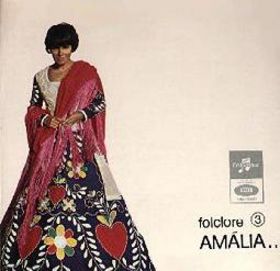
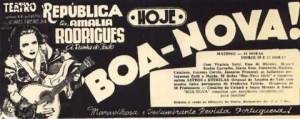 It is at this same point that fado took on the responsibility of being the professional, ‘official’ Portuguese music of loss (or, as several fadologists would seem to prefer, the music of Portuguese loss, which is saying a rather different thing). Salazar’s policies undoubtedly exacerbated this process of fencing-off but did not create it. As with the emergence of rock ’n’ roll in the United States, there are a number of issues to consider when determining why fado canção emerged when it did and why Amália Rodrigues became its paradigmatic performer, ranging from changes in the law (here, the Novo Estado policies were crucially determinant but previously extant copyright laws should not be forgotten, affecting as they do the role of the artist in the period of mass mediation); migration to the cities; changes in recording and media technology; shifts in the high/low divide in the arts.
 Her biographical details resound with references to poverty, to the Mouraria, to singing on the streets while selling fruit, to being discovered in the fado houses and wooed into the world of professional performance and recording, and, ultimately, to living her life in a fog of saudade and permanent unhappiness which no amount of success or fame could shift. The extent to which the development of this persona was deliberate or accidental seems to matter less than the place she came to occupy in the Portuguese imagination.
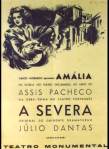 By the time Amália took on the role of Maria Severa in a 1955 Lisbon production of Júlio Dantas’s play, she had already surpassed that early fadista in terms of myth and prominence, due mainly to the success she had achieved internationally. While fado had hardly been unknown outside Portugal previously, it had never reached the level of exposure given it by Amália. Now an international star, she found herself being offered ever increasing opportunities, from performances worldwide to cinema roles nationally and in France. She had also demonstrated a strong desire to explore beyond the limits of traditional fado. It had become increasingly popular for fado singers in the 1940s to move away from the rigidly structured verses of the earlier period towards a freer style based on the work of contemporary poets such as Frederico de Brito. In addition to these newer styles of fado canção, Amália recorded other non-fado and folk songs, as well as Spanish flamenco, Mexican rancheras, and French, English and Italian versions of Portuguese songs (most famously ‘Coimbra’, released in an Italian version under the same title and refashioned as ‘Avril au Portugal’ and ‘April in Portugal’ elsewhere). This explorative aspect of Amália’s approach to her music encouraged musicians and songwriters to approach her with new ideas and led to collaborations that were to have an enormous impact on the direction fado would take.
 On the musical side it is generally agreed, and was frequently admitted by Amália herself, that it was the collaboration with the pianist and composer Alain Oulman which brought about the most far-reaching revolution in her fado style. What Oulman brought to Amália’s work was an ability to break free of established fado styles though a sophisticated musical language, while maintaining a strong link with the essential elements that kept the music recognizable as fado. Amália would rehearse with Oulman at the piano and he would occasionally accompany her on her recordings alongside the time-honoured guitarra and viola. Oulman’s arrangements allowed a greater variety of poetic styles to be utilized for fado lyrics, a development first brought to the public’s attention on the 1962 album Asas Fechadas, popularly known as Busto after the bust of Amália which adorned the cover.
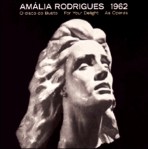 Of the nine tracks on the album seven have music written by Oulman. The lyrics are provided by Rodrigues herself (the famous ‘Estranha Forma de Vida’) and by the poets Luís de Macedo, Pedro Homem de Melo and, mostly, David Mourão-Ferreira, whose 1960 collection À Guitarra e à Viola had been dedicated to Amália and contained the verses for ‘Aves Agoirentas’ ‘Madrugada de Alfama’, ‘Maria Lisboa’ and the political fado ‘Abandono’, all included on Busto. Rodrigues and Oulman also collaborated on the work of less contemporary poets; 1965 saw the release of the EP ‘Amália Canta Camões’ and the album Fado Português, the former containing three adaptations of Portugal’s national poet, the latter harbouring one of the Camões pieces, as well as a cantiga de amigo credited to the medieval troubadour Mendinho, and the title song based on José Régio’s poem, alongside work by Mourão-Ferreira, Homem de Melo and Macedo.
 If the impossibility of dealing with loss comprehensively has led to a sense of a ‘task’ to be achieved, then it is perhaps no surprise to find the term ‘memory work’ increasingly used in contemporary cultural theory. And if one method of going about this work is to employ a ritualistic, or repetitive, process for ‘listing’ loss, then it is worthwhile considering an example of just such memory work, from what I call the ‘I remember’ school of writers inspired by Joe Brainard’s book of the same title. I Remember was first published in 1975 and consisted of a series of entries, all beginning with the words ‘I remember’, in which Brainard recollected moments from his past, some of them highly individual and others doubtless shared by an enormous number of his contemporaries. To take a typical trio of consecutive entries:
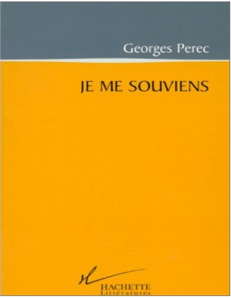 That is not to say, however, that such memory work is necessarily translatable to other cultural contexts. Although Brainard’s book was translated into French by Marie Chaix, the French ‘version’ of I Remember which found most success and which has itself come to be regarded as a classic of the genre, is Georges Perec’s Je me souviens (1978). Perec reduces the autobiographical elements of Brainard’s work to a certain extent, although these are still a prominent feature of his version alongside a higher proportion of memories likely to be shared with others. In producing a more pronounced cultural bias to the book, Perec is forced away from literal translation and towards the creation of a new work steeped in the resonance of the French imaginary. Perec’s intention was to seek out, via his own recollection, moments of memory that could be ‘deconsecrated’ and returned to their ‘collectivity’; speaking about the book he claimed, ‘what came out most clearly for me was that I wasn’t the only one to be remembering. It’s a book I might call “sympathetic”, I mean that it’s in sympathy with its readers, that readers are perfectly at home in it.’
 The fact that Perec’s work increased the ratio of culturally shared to personal memories from Brainard’s original was recognized in 1986 by the British writer Gilbert Adair when he decided to publish his own version of the ‘I remember’ template in his book Myths & Memories. The book was devised partly as a homage to two French writers he admired, Roland Barthes and Georges Perec, and partly as an attempt to apply the techniques of Barthes’s Mythologies and Perec’s Je me souviens to a British context. In Adair’s opinion, Perec’s version of Brainard’s work was distinct enough to warrant its own ‘translation’ but a literal rendering of the French words would be pointless: ‘the fact of its being anchored in a French experience has rendered [Je me souviens] definitively untranslatable; or, rather, translatable only by way of the metamorphosis, the kind of total Anglicizing, which it undergoes here.’ (This observation has an obvious correlation with my earlier discussion of saudade. As for a Portuguese language version of I Remember, the closest parallel would appear to be a Brazilian text entitled Memorando, by Geraldo Mayrink and Fernando Moreira Salles (Sao Paulo: Companhia das Letras, 1993). I have not been able to consult this text to see how it compares with the three versions mentioned here.)
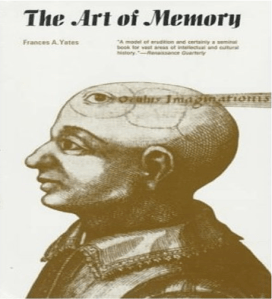 Adair’s conflation of the work of Barthes and Perec serves as an intriguing invitation to think about the concept of mythology alongside that of memory. This has been a strategy taken up by a number of historians in recent years, especially those concerned with memory’s associations with place. Prominent amongst these have been Raphael Samuel and Pierre Nora. Samuel’s ‘theatres of memory’ and Nora’s lieux de mémoire are both influenced by the work of Frances Yates, whose exploration of ‘the art of memory’ relies on notions of myth and place, yet there is an equally important role played by repetition – indeed, memory thought of as an art is born of the desire to be able to repeat. In this sense, it is interesting to note a connection between these historians and the work of the ‘memorians’ of the ‘I remember’ school. In the latter we find a recourse to a ritualistic process (anamnesis, recollection) grounded in the repeated act; this repetition is continued in the representation of memory as these writers follow the unchanging mantra of ‘I remember…’.
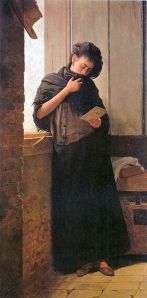 One quality which fado must possess, as all guidebooks will attest, is
 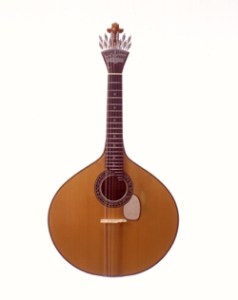 Instrumentally, fado is distinguished by the use of the guitarra portuguesa, a pear-shaped lute- or cittern-like instrument with twelve steel strings (tuned DDAABBEEAABB, from low to high, in the Lisbon style to which I mostly refer). The guitarra is played via a combination of strumming and plucking, using mostly the thumb and index finger, on which are worn unhas (‘nails’). Although in the past the guitarra had provided only harmony, by the period covered in Fado and the Place of Longing it had taken a more dominant role as provider of the melody in instrumental numbers or melodic counterpart to the voice in songs. The other constant accompaniment is provided by the viola (Spanish guitar), which provides harmony and rhythm predominantly but may occasionally lead. In addition, especially in contemporary practice, a viola baixo (acoustic bass guitar) is often added. Additional percussion is rarely used.
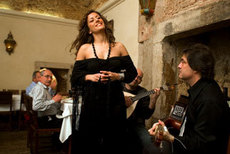 The fado singer, or fadista, tends to take the centre stage in a performance of gesture, phrasing and verbal improvisation that serves to heighten the drama of the lyric and lead the song to an appropriately momentous conclusion. Drama is often emphasized by alternating between registers and songs invariably close on a vocal climax that repeats the last part of the final verse or chorus and is punctuated by a two-chord full stop, or exclamation mark, from the guitars (generally, V–I). Lyrics are of vital importance in fado and, while some are improvised (especially in amateur settings), most are the work of fado lyricists who are not normally involved in the performing group. Adaptations of so-called ‘erudite poetry’ are common and mix with more down to earth variations of a range of lyrical themes.


 The Place of Longing