Henry Ryecroft’s Place of Longing

15 Apr

The Private Papers of Henry RyecroftI have been spending a week in Somerset. The right June weather put me in the mind for rambling, and my thoughts turned to the Severn Sea. I went to Glastonbury and Wells, and on to Cheddar, and so to the shore of the Channel at Clevedon, remembering my holiday of fifteen years ago, and too often losing myself in a contrast of the man I was then and what I am now. Beautiful beyond all words of description that nook of oldest England; but that I feared the moist and misty winter climate, I should have chosen some spot below the Mendips for my home and resting-place. Unspeakable the charm to my ear of those old names; exquisite the quiet of those little towns, lost amid tilth and pasture, untouched as yet by the fury of modern life, their ancient sanctuaries guarded, as it were, by noble trees and hedges overrun with flowers. In all England there is no sweeter and more varied prospect than that from the hill of the Holy Thorn at Glastonbury; in all England there is no lovelier musing place than the leafy walk beside the Palace Moat at Wells. As I think of the golden hours I spent there, a passion to which I can give no name takes hold upon me; my heart trembles with an indefinable ecstasy.

(George Gissing, The Private Papers of Henry Ryecroft (London: Archibald Constable & Co., 1904), pp. 81-2.)

The Music of Fado

15 Apr

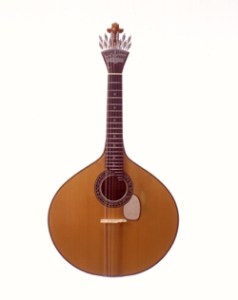
guitarra portuguesaInstrumentally, fado is distinguished by the use of the guitarra portuguesa, a pear-shaped lute- or cittern-like instrument with twelve steel strings (tuned DDAABBEEAABB, from low to high, in the Lisbon style to which I mostly refer). The guitarra is played via a combination of strumming and plucking, using mostly the thumb and index finger, on which are worn unhas (‘nails’). Although in the past the guitarra had provided only harmony, by the period covered in Fado and the Place of Longing it had taken a more dominant role as provider of the melody in instrumental numbers or melodic counterpart to the voice in songs. The other constant accompaniment is provided by the viola (Spanish guitar), which provides harmony and rhythm predominantly but may occasionally lead. In addition, especially in contemporary practice, a viola baixo (acoustic bass guitar) is often added. Additional percussion is rarely used.

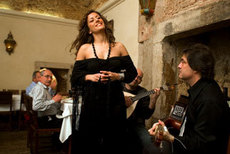
The fado singer Ana MouraThe fado singer, or fadista, tends to take the centre stage in a performance of gesture, phrasing and verbal improvisation that serves to heighten the drama of the lyric and lead the song to an appropriately momentous conclusion. Drama is often emphasized by alternating between registers and songs invariably close on a vocal climax that repeats the last part of the final verse or chorus and is punctuated by a two-chord full stop, or exclamation mark, from the guitars (generally, V–I). Lyrics are of vital importance in fado and, while some are improvised (especially in amateur settings), most are the work of fado lyricists who are not normally involved in the performing group. Adaptations of so-called ‘erudite poetry’ are common and mix with more down to earth variations of a range of lyrical themes.

Stylistically, Lisbon fado can generally be divided into fado castiço (‘authentic fado’, also known as fado fado, fado clássico and fado tradicional) and fado canção (‘song fado’). Fado castiço styles were concretized in the mid-late eighteenth century and include fado corrido (‘running fado’), fado mouraria (named after the Lisbon district discussed earlier) and fado menor (‘minor fado’) and numerous variations of these three basic styles often named after particular guitarists and composers. Salwa Castelo-Branco provides a useful and concise description of the castiço styles:

All three fados have fixed rhythmic and harmonic schemes (I–V) and a fixed accompaniment pattern consisting of a melodic motif that is constantly repeated, at times with slight variation. Using these patterns as a basis, the melody is either composed or improvised. Texts are usually set to one of the most common poetic structures, such as the quatrain or five-, six- and ten-verse stanzas. The accompaniment pattern, the I–V harmonic scheme and the regular 4/4 metre are the identifying elements of these fados and are basically fixed. All other elements are variable. Fado corrido and mouraria, in the major mode, are usually performed in a fast tempo and have similar accompaniment patterns. Fado menor is in the minor mode and is often performed in a slow tempo.

(Salwa El-Shawan Castelo-Branco, ‘Fado’, in L. Macy (ed.), Grove Music Online, http://www.grovemusic.com.)
.

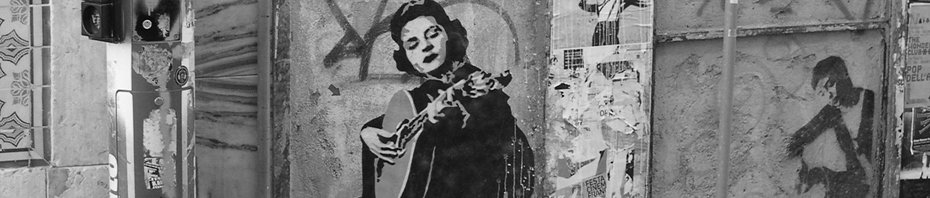
Fado canção was a development of the late nineteenth century and evolved through theatrical revistas (shows). It is distinguished by a stanza- and refrain-based song style and uses more complex harmonic structures. It is this style that came to be associated with Amália Rodrigues and those influenced by her, although both Amália and the ‘new fadistas’ continued to perform the more traditional styles.

Three classic examples of the castiço styles that can be fairly easily sourced are:
Lucília do Carmo, ‘Maria Madalena’ (fado mouraria)
Carlos do Carmo, ‘Por Morrer uma Andorinha’ (fado menor)
Maria Teresa de Noronha, ‘Corrido em Cinco Estilos’ (fado corrido)

Miguel Baptista has posted videos of the basic guitarra styles on YouTube.

Classic examples of fado canção include Alfredo Marceneiro’s ‘Há Festa na Mouraria‘ and Amália Rodrigues’s ‘Gaivota’.

Tudo Isto É Fado

15 Apr

Another oft-quoted introduction to fado’s ontology is a song made famous by Amália Rodrigues entitled ‘Tudo Isto É Fado’ [All of This Is Fado], in which the narrator initially claims not to know what fado is before going on to list a number of its features: ‘defeated souls, lost nights, bizarre shadows in the Mouraria’. The list continues as it leads to the famous refrain: ‘Amor, ciúme / Cinzas e lume / Dor e pecado / Tudo isto existe / Tudo isto é triste / Tudo isto é fado’ [Love, jealousy / Ashes and fire / Sorrow and sin / All of this exists / All of this is sad / All of this is fado.].

The song can be heard here. The full lyrics can be found here.

Sonically, the song provides as good an introduction as any to fado, opening with the distinctive tinkle of the guitarra, leading into the interplay between guitarra and viola (the Portuguese name for the Spanish guitar which is the other main accompanying instrument in fado) and providing an excellent example of Amália’s art as, within the space of the first short verse, she displays her famous melisma (‘perguntaste-me’) and hovers majestically on the word ‘fado’. The song, originally recorded by Rodrigues at Abbey Road in 1952, became one of those on which her reputation as the ‘queen of fado’ would rest.
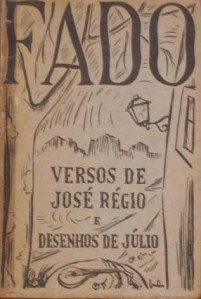
Cover of José Régio's Fado

Another example of fado’s desire to explain itself can be found in a book of poems entitled Fado, produced by José Régio in 1941. Its most famous poem ‘Fado Português’ recounts the maritime myth of fado’s origins, identifying the strong connection to the sea found in Portugal’s history and the loneliness of the mariner in the midst of the watery expanse. ‘Fado’, we are told, ‘was born … In the breast of a sailor / Who, feeling sad, sang’. Régio’s poem was, perhaps inevitably, set to music and became part of Amália’s repertoire. Amália’s version, with music by Alain Oulman, shortened and slightly reworded Régio’s original poem.

Amália’s version can be heard here. Régio’s poem can be found here.

Cover of Fado, Alma de um Povo

The maritime myth is taken to arguably its greatest extreme in Maria Luísa Guerra’s Fado, Alma de um Povo [Fado, Soul of a People], in which the music is presented as an ‘existential cry’ born of the loneliness of the high seas. One of the reasons for the popularity of the maritime origin of fado is the connection to Portugal’s proud seafaring past and its significant colonial endeavours. While one searches in vain in narratives such as Guerra’s for any proof that what we know now as fado really owes its existence to these sailors, the connection to the sea cannot be dismissed. Lisbon has been an important port for centuries and has been witness to the comings and goings of myriad cultures; most commentators agree that it is this mixing of cultural practices along the banks of the Tejo River that most likely gave birth to fado and that, contrary to the nationalist insistence on Portuguese purity, Brazilians and Africans most likely had some involvement in the process.

Whatever the shortcomings of descriptions which lean towards mythology, many are excellent at delineating the world of fado texts, the basis of fado poetics. One could do worse than consult the chapter titles of Mascarenhas Barreto’s Fado: Lyrical Origins and Poetic Motivation to gain an insight into what fado is: Saudade, Bullfighting, Places, Street Cries, Windows/Eyes/Kisses, Sailors, Jealousy, Guitarras, and Destiny are among his principle topics. Guerra, meanwhile, provides her own ‘thematic profile’ of fado: love, hate, shame, separation, hurt, sadness, despair, betrayal, destiny, disgrace, solitude, luck, travel, memory, anxiety, bitterness, fatalism, forgetting, politics, tears, hope, passion, happiness, the human condition, time, life, death, saudade and fado itself. (These words should, of course, be witnessed in their original language: amor, ódio, ciúme, separação, dor, tristeza, despedida, traição, destino, desgraça, solidão, sorte, viagem, lembrança, ansiedade, amargura, fatalismo, esquecimento, política, lágrimas, esperança, paixão, felicidade, condição humana, tempo, vida, morte, saudade, fado.

This seems an extensive list and one which might well be applied to other song genres. Certainly, as one works through it and through the ensuing pages that Guerra devotes to each of these themes, one wonders if there is anything that fado is not about; Guerra herself suggests that it represents a phenomenology of life. Yet the list is also specific enough to give a fairly good demarcation of the world of fado songs. I would wish to add at least the following to it: an obsession with the city of Lisbon; a sense of witnessing, carrying and unburdening, connected to a number of the emotions listed above; and the act of being a fadista. This latter is summed up in Artur Ribeiro’s ‘O Fado de Ser Fadista’ [The Fado/Fate of Being a Fadista ], in which fado is described as ‘everything that happens / When we laugh or cry / When we recall or forget / When we hate or love’.  The question of whether fado was happy or sad was also addressed – poetically, if indecisively – by the great modernist poet Fernando Pessoa:

All poetry – and song is an assisted poetry – reflects what the soul lacks. For this reason, the song of sad people is happy and the song of happy people is sad. Fado is neither happy nor sad. It is an episode of the interval … Fado is the weariness of the strong soul, the gaze of contempt that Portugal directs to the God in whom it believed and who abandoned it.

(This statement, much cited but rarely referenced, appeared in a piece Pessoa wrote for Notícias Ilustrado, published on 14 April 1929.)

Cover of Pinto de Carvalho's Historia do Fado

While it is possible to find accounts of fado dating back to the eighteenth century, and while writers such as Guerra have been keen to highlight an archaeology of fado discourse stretching even further, the debates described here are generally sourced from a number of works that have appeared in the twentieth century. In many ways, the fadology alluded to here can be said to have been born with the twentieth century for two important reasons. Firstly, the appearance of José Pinto de Carvalho’s history of fado in 1903 serves as a major source for subsequent histories and thus casts a giant shadow across the historiography of the genre. Secondly, and more controversially, in considering fado as a durable musical genre from the perspective of the twenty-first century, I suggest that fado, like so many musical genres we are now accustomed to, is an invention of the phonographic era. It is this era, and in particular its twentieth century formulation, that has ‘fixed’ musical styles and genres like no other before it, even as it has allowed for seemingly endless new experimentation, cross-genre fusion and deconstruction.
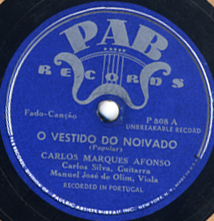
Label from a fado 78

The phonographic era has also led to the possibility to disseminate the music to a much wider audience than ever before. While English language descriptions of fado practice from the nineteenth century are invariably sourced from travel literature, and while twentieth century folklorists and ethnomusicologists have continued to provide accounts from the field, it has nevertheless been possible for many to indulge in the virtual tourism of experiencing fado via its mediation in films and recordings. This has created a desire for information about the music in languages other than Portuguese. A comprehensive fado history in English has yet to be completed, although Paul Vernon’s A History of the Portuguese Fado goes part of the way towards achieving this goal. Vernon’s work leans heavily on Rodney Gallop’s analysis of fado from the 1930s and is somewhat lacking in translations of subsequent Portuguese scholarship. To find other work on fado in English, it has been necessary to seek out scholarly articles in music encyclopaedias and general accounts in world music guidebooks, magazines and websites, although happily this situation is starting to change.

Mythology

1 Mar

A cheap café in the Mouraria district, at the entrance to the Rua do Capelão. An assortment of herdsmen, cattle traders, merchants and prostitutes. Stage left, a small staircase leading to the guest rooms, where the Count of Marialva is lodged. A balcony stage right. At the rear a doorway with three stone steps leading to the alley. On one of the tables lies a guitar.

(Júlio Dantas, A Severa (Peça em Quatro Actos), 4th edn (Lisbon: Sociedade Editora Portugal-Brasil, c. 1920), p. 9.)

With these lines the scene is set for the first act of Júlio Dantas’s 1901 play A Severa, the story of the Lisbon fadista Maria Severa (1820-1846) and her affair with the slumming Count of Marialva. The play, along with other books, films and songs which recount the tale of the doomed Severa, amply illustrates the blurring of myth and history that is bound up with fado history and historiography–what I occasionally refer to as ‘fadology’. The character of Severa that Dantas presented–firstly as the heroine of a novel that made its appearance just prior to its theatrical dramatization–was based on a real fadista of the mid-nineteenth century, whose affair with a count (Vimiosa, not Marialva) and whose tragic death passed into local and then national lore as the epitome of fado and the fadista’s world. From this point on Severa became a recurring figure in the cultural world of Lisbon, not least as the subject of numerous songs (some preceding, some derived from or influenced by Dantas’s play). The play itself was performed on a number of occasions throughout the twentieth century, with many notable actresses taking the part of Severa, including, in 1955, fado’s greatest star, Amália RodriguesA Severa was also adapted by the filmmaker Leitão de Barros in 1931 to become the first Portuguese sound film. The film, scored by Frederico de Freitas, produced a handful of songs which, through performances by Amália (‘Rua do Capelão’, ‘O Timpanas’, ‘Novo Fado da Severa’) and more recently by ‘new fadistas’ such as Dulce Pontes (‘Novo Fado da Severa’) and Lula Pena (‘Rua do Capelão’), have served to keep the story of Severa alive.

The Dantas quotation above is also notable for the presence of a number of what we might call ‘fado mythemes’. I use this term to reflect the elements of fado stories–those expressed via acts of speech and song and via the written word (novel, play, lyric, history)–that, through constant repetition, come to represent, in however varied or mutated a fashion, a large part of the ‘fado-ness’ of fado (its ontology, as it were). I am thinking of these mythemes as distinct from the musical expression of fado, which comes from a particular set of instrumental and vocal styles.

Alleyway in Alfama

Alleyway in Alfama

From Dantas’s short scene-setting paragraph we can already detect a number of mythemes.

1. The cheap café.  The reference to a bohemian space and its concomitant possibility of transgression is of vital importance when considering the character of Marialva and how and why he has come to be lodging here. For the other characters present, the café provides an obvious meeting place for urban and rural types to mix with each other in a relaxed environment and to come together in appreciation of various pleasures, not least fado music.

2. Mouraria. The Mouraria and Alfama districts of Lisbon are the clearest remnants of the Moorish occupation of the city, their maze-like alleyways and steep steps covering the hillsides below the Castelo de São Jorge. Known as the birthplace of fado, these areas have been associated with the genre ever since its emergence in the mid-nineteenth century. Rodney Gallop, writing in 1933, noted that

[fado’s] true home is Alfama and Mouraria, the poor quarters of the city, which flaunt their picturesque squalor on the slopes below St George’s Castle. A walk through these steep, narrow streets on a moonlit night is likely to be rewarded with the sound of a guitar and the mournful cadences of the triste canção do sul [sad song of the south]. But to hold it surely in one’s grasp it is best to go to one of the popular cafés such as the ‘Luso’ and the ‘Victoria’ where it is regularly performed by semi-professional fadistas.

(Rodney Gallop, ‘The Fado: The Portuguese Song of Fate’, The Musical Quarterly, Vol. 19, No. 2 (1933), p. 199.)

Gallop was writing shortly after the enforced professionalization of fado introduced by the government of António Salazar, a move that encouraged the development of venues such as O Luso that took fado away from its ‘true home’ and placed it in the more respectable bourgeois environs of the grand Avenida da Liberdade. This move was crucial in forming the split between (clandestine) amateur fado performance and its professional counterpart, with the latter becoming more or less delimited as a new song style (and therefore easier to ‘hold … surely in one’s grasp’). At the same time this move away from the Mouraria area only enhanced the romantic mythology that has sprung up around the latter’s ‘picturesque squalor’, a romanticization that would increase with the literal disappearance of much of the lower Mouraria through urban renovation projects undertaken by the Estado Novo, the name given to the ‘New State’ ushered in by Salazar in 1933.

3. The popular classes. This phrase is used here not to denote a distinct working class but to signal the plurality of ‘low others’, perhaps better understood as a lumpen proletariat, often found in romantic-mythical accounts of fado history. Fado’s origins, as most writers on the subject have been keen to make clear, were very much bound up in the experiences of the popular classes centred in the city of Lisbon. Whether born into the Lisbon underclass or newly arrived from the countryside, from nearby coastal villages or from Portugal’s colonial outposts, these people, living in the poor areas that had flourished in the shadow of the grandly designed post-earthquake city–the modern Lisbon conceived by the Marquês de Pombal  in the eighteenth century–came together to form the crucible from which fado would emerge. As a mytheme–a single feature which can signify without recourse to further reduction–one would be hard pushed to better the symbolic character of the street vendor, who features in so many descriptions of fado and Lisbon life through the nineteenth and twentieth centuries. A central mytheme–or, following Roland Barthes, ‘biographeme’ –of fado’s greatest star, Amália Rodrigues, is the image of her selling fruit on the streets of Lisbon in the years immediately preceding her discovery and subsequent fame.

4. Marialvismo. This concept stems not from the fictionalized character of Dantas’s work but from the eighteenth century Marquês de Marialva, author of a treatise on horsemanship. Marialva’s son, a bullfighter whose death in the ring was famously avenged by the Marquês, was known, like Vimiosa, to frequent the bars and dark alleyways of the Mouraria district of Lisbon. Marialvismo became associated with a certain representation of masculinity that , as Miguel Vale de Almeida points out, was very much connected to processes of change within Portugal.

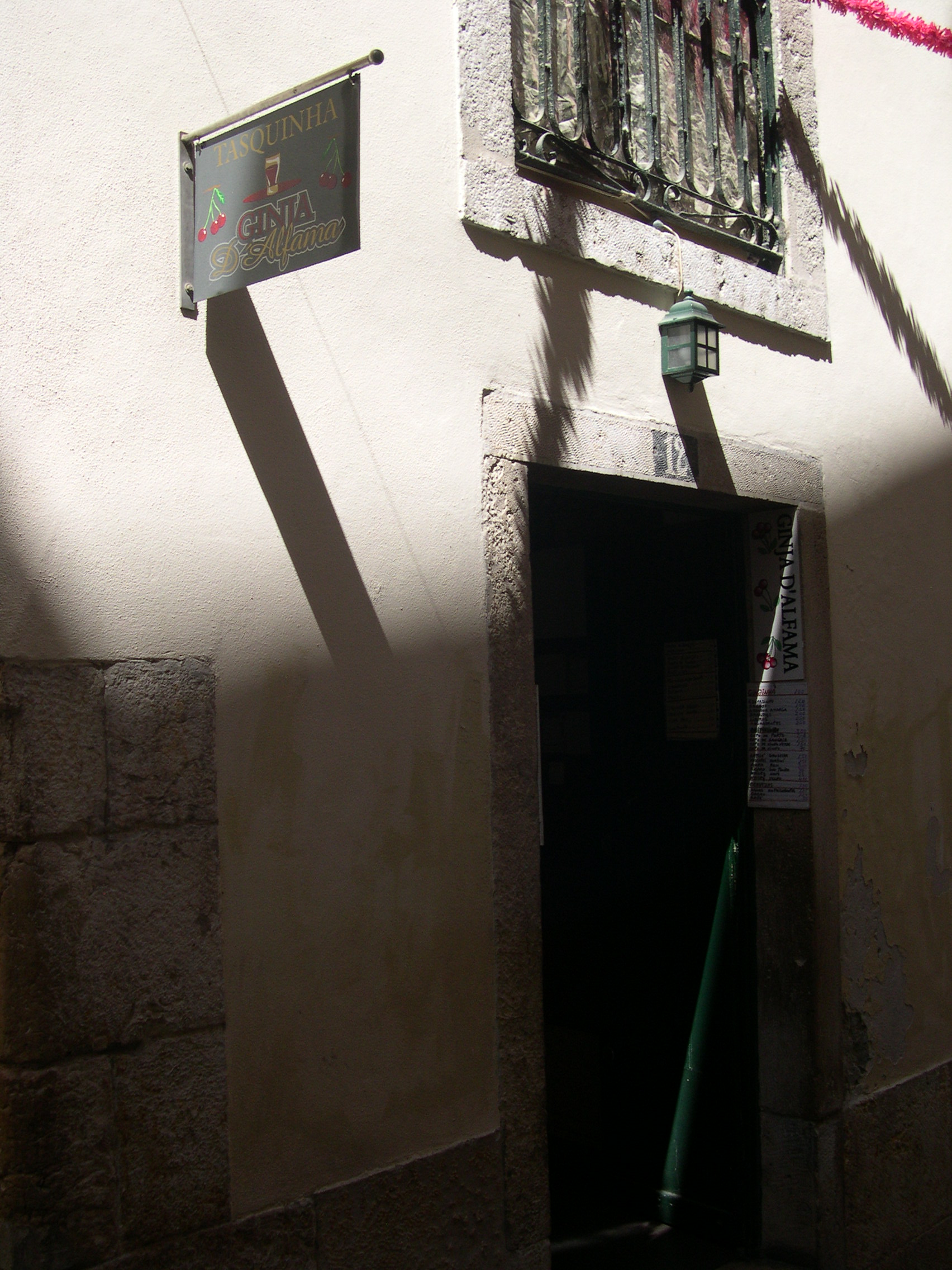
5. The alleyway/shadows. Alleyways in fado work, as in many modern narratives, as locations of urban secrecy. The roles of the dingy ill-lit bar and bustling public street become reversed at night-time–when so many of these stories take place–and the alleyway, plunged into shadows through its contrast with other sources of light, becomes a place of otherness. Also, like the ‘dark end of the street’ of Dan Penn’s and Chips Moman’s classic soul song, the alleyway becomes a locus for transgression, for acting out a series of relationships not possible under the symbolic scriptural (daytime) law. Added to this are a whole set of tropes regarding light and dark, public and private, safety and danger, life and death. Shadows are regularly featured in fado discourse, as evidenced by the book Fado: Vozes e Sombras and the documentary Fado: Ombre et Lumière, as well as in fado iconography (see, for example, the cover photograph of David Cohen’s book Fado Português).

6. The guitar. One of the most notable features of fado music is its use of the guitarra portuguesa, an aspect of the music that has tended to lead to a virtual synonymy between fado and guitarra. From this brief reference in Dantas’s introduction we are left in little doubt that fado music has been, or is about to be, played. The imagery of the guitarra has proven irresistible to fadologists since the concretization of the style, and much space has been given over to the history of the instrument and its possible origins, leading to often explicitly ideological positions of ownership and appropriation. The guitarra is a central feature of José Malhoa’s much-reproduced painting O Fado, which shows a man playing the instrument while a woman leans on a table gazing at him. Many early paintings, prints and publicity photos featured women singers playing guitarras, as Severa was supposed to do, something that is not reflected in most modern fado practice, however, where women players are as unusual as female guitarists in flamenco.

José Malhoa’s "O Fado"

José Malhoa’s "O Fado"

Malhoa’s painting was the inspiration, in its turn, for a fado recorded by Amália Rodrigues. José Galhardo’s ‘Fado Malhoa’ describes the work as ‘the most Portuguese of oil paintings’ and the guitarist as ‘a real local/a real Lisboan/a bohemian and a fadista’. In 1947, a short film was shot of Amália and the guitarrista Jaime Santos recreating Malhoa’s scene. An extract from this ‘promo video’ can be seen in the documentary The Art of Amália (Bruno de Almeida, Portugal/USA, 2000).

Fadista

1 Mar

The word fadista is used in a variety of ways in my book, as it is in fado discourse: it is used to describe the mixture of ‘roughs’ (an analogy made by Pinto de Carvalho, one of the first serious historians of fado, in 1903), criminals, prostitutes and aristocratic libertines who made up the bohemian fado milieu of the nineteenth century; in a later set of developments, it comes to refer to performers and writers of fados, as well as to fans and aficionados of the music. It is a mark of appreciation for audience members to shout ‘Fadista!’ [faadeeeshta!] at climactic moments of a particularly authentic performance.

Fado and the Place of Longing

7 Jan

This blog is being set up to accompany my book Fado and the Place of Longing: Loss, Memory and the City (Ashgate, 2010). I hope to post draft extracts from the book, research notes and pictures relating to the project. While the book itself is specifically about the Portuguese musical style known as fado, I want to reflect on the “place of longing” more generally as well.

The book is a result of research I have carried out on fado over the past five or six years. This research followed a period of living and working in Lisbon, although the research really established its focus when I moved to Newcastle upon Tyne to embark on a PhD at Newcastle University. My PhD thesis, entitled ‘Loss, Memory and Nostalgia in Popular Song: Thematic Aspects and Theoretical Approaches’ included a chapter on fado alongside others on Latin American nueva canciön, black protest music in the USA (specifically the work of Nina Simone) and punk and post-punk in Britain. More information about his project can be found here, along with some downloadable papers.

I decided to expand my work on fado into a longer project after completing my doctorate, and put together a proposal early in 2008. Ashgate expressed interest in publishing the book and I wrote it between July 2008 and July 2009.

There were numerous reasons I could see to write this book. There was, I pereceived, a significant amount of interest in fado at both national (Portuguese) and international levels. The rise in global popularity of the so-called ‘new fadistas’ over the last decade had led fado to a level of visibility unmatched since the heyday of the internationally-renowned performer Amália Rodrigues. Current fado performers, in particular Mariza, had found themselves at the forefront of a star system promoted by the contemporary world music network. Fado was being regularly reviewed in the Anglophone music press, with leading world music publications such as Songlines and fRoots featuring Mariza and other performers in prominent articles. Two films had recently been completed on the contemporary fado scene, Simon Broughton’s Mariza and the Story of Fado (2007) and Carlos Saura’s Fados (2007) and the time seemed right for a thoroughly-researched English language monograph on the genre.

To date, the only book-length study of fado music in English had been Paul Vernon’s A History of the Portuguese Fado (Ashgate, 1998). The main strengths of Vernon’s book lie in its account of the Portuguese music industry in the mid-twentieth century, its presentation of archival material relating to recording sessions by key performers such as Amália Rodrigues, and its ethnological account of a fado venue in the 1980s. It suffers from a number of drawbacks, however. For a start, there is an over-reliance on English language scholarship on fado which had not progressed far from Rodney Gallop’s work in the 1930s. Vernon does not provide translations, or even summaries, of subsequent Portuguese scholarship in the area and any sense of the debates which shaped fado discourse and practice during the second half of the twentieth century is subsequently lacking.

Furthermore, Vernon’s presentations of key fado performers are rather cursory and, while a number of fados are quoted (although without Portuguese versions for reference), one does not get a sense of the full range of topics with which fado music engages. Additionally, Vernon’s book appeared shortly before the current fado ‘boom’, meaning that there is much to be updated for those wishing to place the work of current performers such as Mariza, Cristina Branco and Ana Moura in its proper historical context. I hoped my book would partly fill a gap left in the scholarship by providing translations and summaries of recent Portuguese work on fado, presenting a more full-realised historical account of fado recording in the second half of the twentieth century, giving detailed accounts of fado song texts and examining the continuities and discontinuities in current fado practice.

In addition to the filling a gap in English language work on fado, I hoped that a project such as this would have some resonance beyond its immediate subject matter by engaging with debates in the fields of memory studies, historiography and media studies. My examination of the role of the city in fado song texts can be compared to work in other areas on what M. Christine Boyer has called ‘the city of collective memory’. By engaging with theories of witnessing, I hoped to contribute to other contemporary work on the uses of memory, archival culture and the politics of reconciliation. By focussing on recent developments in fado music, I wanted to extend the existing fado historiography to suggest processes of continuity and change in the mediation of highly memory-oriented cultural practices.

Having now completed the book, I think I have been able to achieve most of these aims, with the possible exception of ‘giving detailed accounts of fado song texts’, this being largely due to the unreasonable demands of certain copyright holders who fail to see how the quotation of a few song lyrics might be considered ‘fair use’ in the context of an academic text being produced in a very limited print run and from which the author stands to gain no profit. Such intransigence is even more baffling when one reflects on how easily available many of these song texts are on the Internet. What is not possible, then, in print publishing will be acheivable in a forum such as this where links can be posted to sites hosting lyrics, recordings and videos.

My research also led me to areas I had not fully explored before, such as the fascinating spatial theories of Henri Lefebvre, Gaston Bachelard and the large number of cultural geographers influenced by them. While my work had always been about the city in one way or another – specifically the (mis)remembered city of Lisbon – these thinkers gave me a range of new perspectives that showed it was not enough merely to think about the representation of spaces, but also to try and think spatially to a similar extent to which we have all learned to think temporally. The place of longing, then, is many things. It may be a specific space – for me, for this project, the endlessly mapped city of Lisbon that saturates fado song texts. It may be an attempt to put longing itself – and its correlatives: yearning, loss, mourning, nostalgia, memory, melancholy and that wonderful Portuguese word, saudade – into some kind of context. It may be an attempt to situate a particular genre or style – in my case, fado – in a much broader field. I found myself attempting all of these tasks and more.