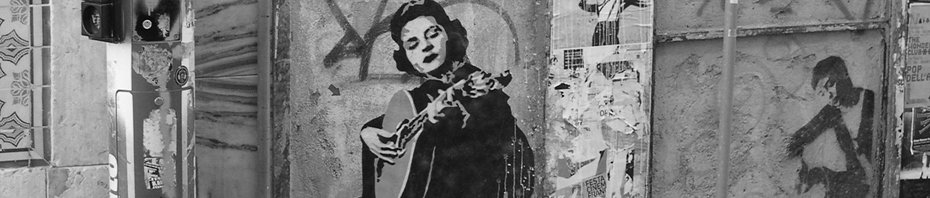
For the city is a poem … but not a classical poem, not a poem centered on a subject. It is a poem which deploys the signifier, and it is this deployment which the semiology of the city must ultimately attempt to grasp and to make sing.
(Roland Barthes, ‘Semiology and Urbanism’, in The Semiotic Challenge, tr. Richard Howard (Berkeley and Los Angeles: University of California Press, 1994), p. 201.)
We witness the advent of the number. It comes with democracy, the large city, administrations, cybernetics. It is a flexible and continuous mass, woven tight like a fabric with neither rips nor darned patches, a multitude of quantified heroes who lose names and faces as they become the ciphered river of the streets, a mobile language of computations and rationalities that belong to no one.
(Michel de Certeau, The Practice of Everyday Life, tr. Steven Rendall (Berkeley & Los Angeles: University of California Press, 1984), p. v.)
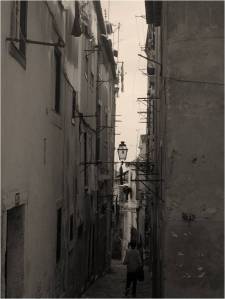


Fado and the Place of Longing takes as one of its subjects the centrality of the city of Lisbon in fado texts. Fado, through the combination of word, music and gesture that has become solidified as the music’s style, performs place in a very particular way, summoning up a mythology that attempts to trace the remembered and imagined city of the past via a poetics of haunting. At the same time certain locales of the physical city present themselves as exhibits in a ‘museum of song’, offering up haunted melodies of a Portuguese sonic past that serves to assert the city’s identity.
The ubiquity of Lisbon’s presence in fado lyrics is exemplified by the song ‘Vielas de Alfama’ [Alleyways of Alfama], created by Artur Ribeiro and Maximiano de Sousa (commonly known as Max) in the middle of the twentieth century and revisited at the start of the twenty-first by Mariza on her album Fado Curvo (2003). The song hymns the eponymous alleyways of the ancient Alfama quarter and of ‘old Lisbon’, claiming ‘Não há fado que não diga / Coisas do vosso passado’ [There isn’t a fado / That doesn’t speak of your past]. At the close of the refrain, the singer wishes ‘Quem me dera lá morar / P’ra viver junto do fado’ [If only I could live there / To live close to the fado’]. A fado menor performed by Carlos do Carmo and his mother Lucília goes even further: ‘Não há Lisboa sem fado, não há fado sem Lisboa’ [There is no Lisbon without fado, no fado without Lisbon]. Whether referencing the city as a whole or one of the neighbourhoods most associated with the genre – Alfama, Mouraria, Bairro Alto and Madragoa – fado texts provide topographies of loss that place the city as either object of desire or lack or as backdrop to another lost, remembered or desired object.

‘Fado Lisboa’ is a song that celebrates the city as a whole. It was originally performed by Ercília Costa (one of the great fado stars of the twentieth century) in a revista from 1939, O Canto da Cigarra. The song has also been performed by Lucília do Carmo under the title ‘Sete Colinas’, after the ‘seven hills’ of Lisbon. It has a distinctly royal tone and speaks of Lisbon as ‘casta princesa’ [chaste princess], going on to declare how beautiful the city must be ‘Que tens de rastos aos pés / A majestade do Tejo’ [That you have kneeing at your feet / The majesty of the Tejo]. As in many songs about Lisbon, the city is explicitly feminized. It also stresses Lisbon as a centre of empire, praising the discoverers who found ‘so many deserted lands’ and the heroes created in Madragoa, one of the historic quarters of Lisbon.
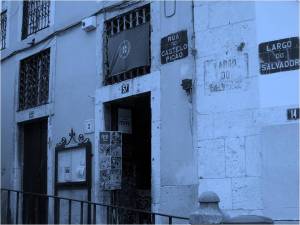
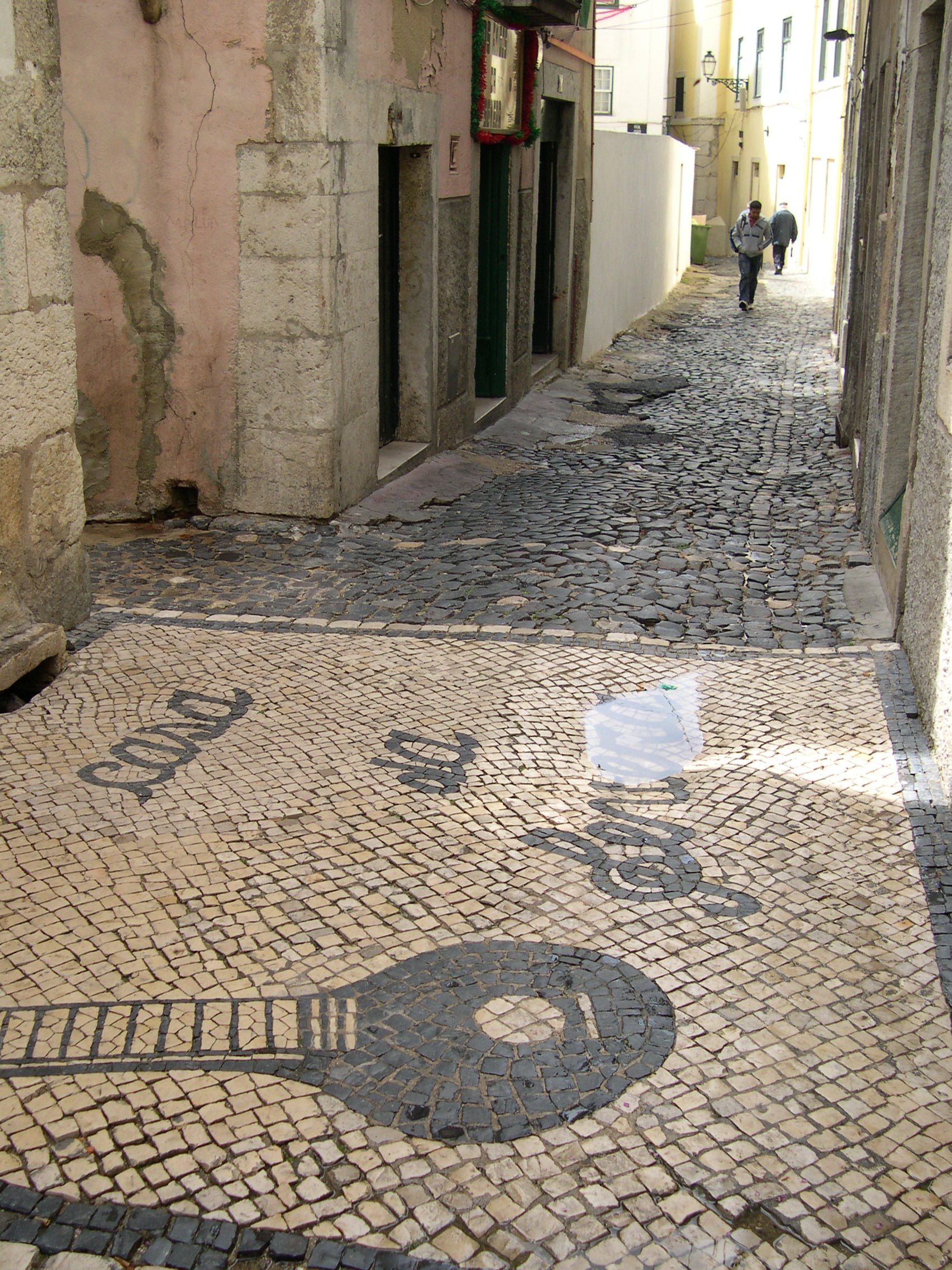
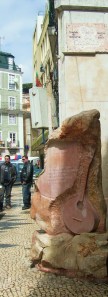 ‘É Noite na Mouraria’ [It’s Night in Mouraria], a fado performed by Amália Rodrigues and her sister Celeste, moves us toward a more particular location. Later recorded by Katia Guerreiro and Mísia, it is a typical ‘atmosphere’ song, listing a number of the mythemes we have come to expect from a fado narrative: the low sound of a guitarra, a fado being sung in a dark alleyway, the whistle of a boat on the Tejo, a passing ruffian. This fado works as a companion piece to the classic song of fado’s ontology, ‘Tudo Isto É Fado’; the delivery is not dissimilar, comparable mythemes are present, and there is a declaration in the song that ‘all is fado / all is life’. Mouraria is also represented in fados that mention the Rua da Capelão, linked forever to the name of Maria Severa and to the birth of modern fado. The most famous, ‘Rua do Capelão’ (with words by Júlio Dantas and music by Frederico de Freitas), places the street at the centre of the Severa story. The site of Severa’s house is now commemorated in a very Portuguese fashion, having its own dedicated pattern in the calçada, the white and black cobbled pavements found throughout Lisbon. At the entrance to the street there is also a monument to mark its place in history, consisting of a sculpture of a guitarra with the words ‘Birthplace of fado’ beside it. In this way, fado does not only reflect the city’s presence, but asserts its own presence in the city. One can, if one desires, use the Rua do Capelão as the start of a walking tour of the city solely based on fadistic associations, from the labyrinth of Mouraria’s streets up the slopes surrounding the Castelo de São Jorge to the neighbourhoods of Alfama, Graça and Madragoa.
Lucília do Carmo can again be our guide to Madragoa when she sings, in a fado named after the neighbourhood, of the Madragoa ‘of the bakers and fish sellers / Of tradition’. This is the ‘Lisbon that speaks to us / From another age’. The verse of this fado utilizes an associative turn of phrase common to a number of ‘city fados’; another associative fado, ‘Ai Mouraria’ speaks of ‘the Mouraria of nightingales under the eaves’, ‘of pink dresses’, and ‘of Severa’. These associations have a similar function to the texts written by the authors of the ‘I remember’ school, evoking both personal and collective memories. The ‘Mouraria of processions’ is also the Mouraria associated with the object of the singer’s affections: both are now gone.

Zooming in still further, we encounter the alleyway, an unavoidable feature of the neighbourhoods surrounding the Castle. Alleyways are both places of intimacy (as in ‘Vielas de Alfama’ where they are ‘kissed by the moonlight’) and transgression (like the alleyway in Júlio Dantas’s A Severa). In the fado ‘A Viela’ (‘The Alleyway’), we meet a ‘typical’ character walking from alleyway to alleyway and encountering a ‘lost woman’ there. The fado was recorded by Alfredo Duarte, better known as ‘Marceneiro’ after the name of his trade (joiner). Born in 1891, Marceneiro had a closer connection than many to fado’s past by the time he was officially ordained the ‘king of fado’ in 1948. For many he was the living embodiment of the tradition, a castiço singer who, while born in the phonographic era, did not seem part of it. Indeed, Marceneiro was deeply suspicious of recordings; his true home was in the fado houses of Lisbon, where, from the mid-century onwards, he was considered a living legend. If, as Rodney Gallop had suggested in the 1930s, one had to go a club such as the Luso to hold the fado ‘surely in one’s grasp’, then one could look for no better guardian than Marceneiro. A regular at the Luso, he transcended the venue, connecting back to a time before the forced professionalization of fado performance. Marceneiro, then, is associated with the city not only because of fados like ‘A Viela’, but also in his very being, an authentic fadista who sang about the city, was mainly known in the city, and who represented the city (or a certain image of it) more than the cosmopolitan Amália. Much the same could be said for Fernando Farinha, with whom Marceneiro collaborated on occasion (most notably on the fado ‘Antes e Depois’). Farinha, known as the ‘Miúdo da Bica’ [Kid from Bica] after the neighbourhood in which he lived, sang mainly of his life and the city he lived in. Farinha was not averse to recording, however, nor to appearing in films, such as the one that bears his nickname. His most famous recording, ‘Belos Tempos’, is rich with nostalgia and describes a desire to go back to the time of Maria Severa. Like Severa, Farinha’s presence is marked in the city itself, on a plaque in Bica, the neighbourhood he helped to make famous.
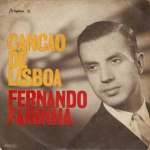 We might say, then, that the discourse surrounding Marceneiro and Farinha is one rich with ‘authenticity work’. This work is done through ceaseless reminders of the connection between the performer and the neighbourhood/city; Farinha is ‘do povo’ but also ‘da Bica’, ‘de Lisboa’ and, ultimately, ‘do fado’. From this position he could then make claims to the city and its music, as he did throughout his career. Marceneiro was a similarly ‘ordained’ commentator on the city, as can be heard on his version of Carlos Conde’s ‘Bairros de Lisboa’, where the city’s presence is introduced by the framing device of a walk through its streets. The verses, sung as a duet with Fernanda Maria, present a sort of competition between various neighbourhoods as to which is most relevant to fado: Campo de Ourique is the most elevated, Alfama is the most famous, the most fadista and maritime, Mouraria evokes the most nostalgia, Bairro Alto is praised for its inhabitants, Madragoa for its youthful optimism. In the end, there is a realization that the city should not be reduced to its parts: ‘Why go any further / If Lisbon is all beautiful / And Lisbon is our neighbourhood!’
But, as is no doubt clear from many of the lyrics quoted above, the Lisbon being spoken about in many fados is a city of the past. If, having read the inscription on the monument at the entrance to the Rua do Capelão, we turn around and face the opposite direction, this city of the past quickly vanishes.
 Mísia, for her part, chose to revisit the song on her 2001 album Ritual, having already recorded a version for her second album in 1993. Where the
  A glance through the part of Amália’s
 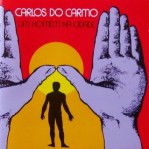 It was Amália’s simultaneous ability to court these poets while remaining free from the persecutions of the Estado Novo that came to infuriate many people and that still divides opinion on the singer now. For her critics, Amália’s political naivety smacked too much of the populism peddled by Salazar himself; this was hardly helped by the fact that fado and Amália had become synonymous and that, as fado now became tarred through association with the old regime, so, many felt, should its foremost proponent. This, allied to the sheer excitement of the new forms of music springing up in the wake of the canto de intervenção movement and imported Anglo-American rock music, helped to push fado out of the spotlight in the early days of democracy. Yet fado did not go away and neither did Amália, though her career took a definite downward turn within Portugal for a few years. It was during this period that Carlos do Carmo emerged as the new lantern bearer of fado. Less politically naive than Amália, Carmo brought a commitment to the ideas of the Revolution together with love, deep knowledge and experience of fado gained from his mother, the famous fadista Lucília do Carmo, and from the fado house he inherited from his father. Carmo worked frequently with the poet José Carlos Ary dos Santos and attempted, like Rodrigues and Afonso before him, to bridge the music of the city with that of the countryside. His most notable achievements in this respect were the albums Um Homem na Cidade (1977) and Um Homem no Pais (1983), built upon Santos’s lyrics.
 When Amália did return it was in triumph, performing to packed houses and initiating a new series of recordings which, though they would often veer towards the gimmicky, nonetheless paved the way for her powerful albums of self-written material at the beginning of the 1980s. It is perhaps worth considering Geoffrey O’Brien’s discussion of the return of Burt Bacharach in the 1990s when considering both Amália’s post-Revolution comeback and her audience’s willingness to re-embrace her. The songwriting process that Bacharach and his colleagues symbolize is comparable to the creative process of fado canção, which can be seen as the driving force behind the musical period covered in Fado and the Place of Longing. Like Rodrigues’s ‘classic’ period, Bacharach’s period was one of professionals – a Hollywood-style division of labour – as opposed to the singer-songwriter style that would come to dominate afterwards; O’Brien describes the process as ‘a combination of perfectionism and commercialism’. Eduardo Sucena’s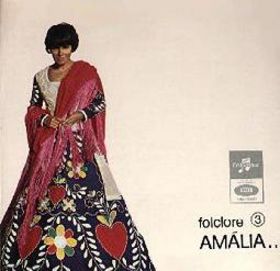
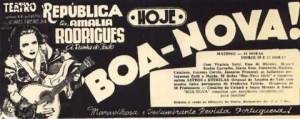 It is at this same point that fado took on the responsibility of being the professional, ‘official’ Portuguese music of loss (or, as several fadologists would seem to prefer, the music of Portuguese loss, which is saying a rather different thing). Salazar’s policies undoubtedly exacerbated this process of fencing-off but did not create it. As with the emergence of rock ’n’ roll in the United States, there are a number of issues to consider when determining why fado canção emerged when it did and why Amália Rodrigues became its paradigmatic performer, ranging from changes in the law (here, the Novo Estado policies were crucially determinant but previously extant copyright laws should not be forgotten, affecting as they do the role of the artist in the period of mass mediation); migration to the cities; changes in recording and media technology; shifts in the high/low divide in the arts.
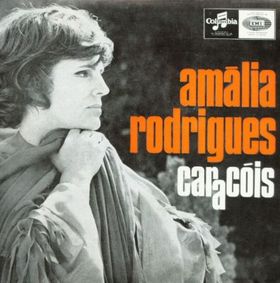
 Her biographical details resound with references to poverty, to the Mouraria, to singing on the streets while selling fruit, to being discovered in the fado houses and wooed into the world of professional performance and recording, and, ultimately, to living her life in a fog of saudade and permanent unhappiness which no amount of success or fame could shift. The extent to which the development of this persona was deliberate or accidental seems to matter less than the place she came to occupy in the Portuguese imagination.
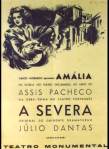 By the time Amália took on the role of Maria Severa in a 1955 Lisbon production of Júlio Dantas’s play, she had already surpassed that early fadista in terms of myth and prominence, due mainly to the success she had achieved internationally. While fado had hardly been unknown outside Portugal previously, it had never reached the level of exposure given it by Amália. Now an international star, she found herself being offered ever increasing opportunities, from performances worldwide to cinema roles nationally and in France. She had also demonstrated a strong desire to explore beyond the limits of traditional fado. It had become increasingly popular for fado singers in the 1940s to move away from the rigidly structured verses of the earlier period towards a freer style based on the work of contemporary poets such as Frederico de Brito. In addition to these newer styles of fado canção, Amália recorded other non-fado and folk songs, as well as Spanish flamenco, Mexican rancheras, and French, English and Italian versions of Portuguese songs (most famously ‘Coimbra’, released in an Italian version under the same title and refashioned as ‘Avril au Portugal’ and ‘April in Portugal’ elsewhere). This explorative aspect of Amália’s approach to her music encouraged musicians and songwriters to approach her with new ideas and led to collaborations that were to have an enormous impact on the direction fado would take.
 On the musical side it is generally agreed, and was frequently admitted by Amália herself, that it was the collaboration with the pianist and composer Alain Oulman which brought about the most far-reaching revolution in her fado style. What Oulman brought to Amália’s work was an ability to break free of established fado styles though a sophisticated musical language, while maintaining a strong link with the essential elements that kept the music recognizable as fado. Amália would rehearse with Oulman at the piano and he would occasionally accompany her on her recordings alongside the time-honoured guitarra and viola. Oulman’s arrangements allowed a greater variety of poetic styles to be utilized for fado lyrics, a development first brought to the public’s attention on the 1962 album Asas Fechadas, popularly known as Busto after the bust of Amália which adorned the cover.
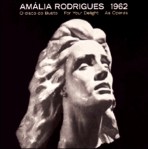 Of the nine tracks on the album seven have music written by Oulman. The lyrics are provided by Rodrigues herself (the famous ‘Estranha Forma de Vida’) and by the poets Luís de Macedo, Pedro Homem de Melo and, mostly, David Mourão-Ferreira, whose 1960 collection À Guitarra e à Viola had been dedicated to Amália and contained the verses for ‘Aves Agoirentas’ ‘Madrugada de Alfama’, ‘Maria Lisboa’ and the political fado ‘Abandono’, all included on Busto. Rodrigues and Oulman also collaborated on the work of less contemporary poets; 1965 saw the release of the EP ‘Amália Canta Camões’ and the album Fado Português, the former containing three adaptations of Portugal’s national poet, the latter harbouring one of the Camões pieces, as well as a cantiga de amigo credited to the medieval troubadour Mendinho, and the title song based on José Régio’s poem, alongside work by Mourão-Ferreira, Homem de Melo and Macedo.
 If the impossibility of dealing with loss comprehensively has led to a sense of a ‘task’ to be achieved, then it is perhaps no surprise to find the term ‘memory work’ increasingly used in contemporary cultural theory. And if one method of going about this work is to employ a ritualistic, or repetitive, process for ‘listing’ loss, then it is worthwhile considering an example of just such memory work, from what I call the ‘I remember’ school of writers inspired by Joe Brainard’s book of the same title. I Remember was first published in 1975 and consisted of a series of entries, all beginning with the words ‘I remember’, in which Brainard recollected moments from his past, some of them highly individual and others doubtless shared by an enormous number of his contemporaries. To take a typical trio of consecutive entries:
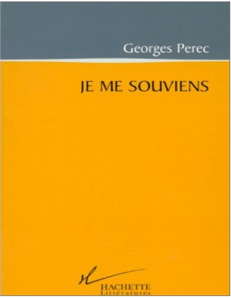 That is not to say, however, that such memory work is necessarily translatable to other cultural contexts. Although Brainard’s book was translated into French by Marie Chaix, the French ‘version’ of I Remember which found most success and which has itself come to be regarded as a classic of the genre, is Georges Perec’s Je me souviens (1978). Perec reduces the autobiographical elements of Brainard’s work to a certain extent, although these are still a prominent feature of his version alongside a higher proportion of memories likely to be shared with others. In producing a more pronounced cultural bias to the book, Perec is forced away from literal translation and towards the creation of a new work steeped in the resonance of the French imaginary. Perec’s intention was to seek out, via his own recollection, moments of memory that could be ‘deconsecrated’ and returned to their ‘collectivity’; speaking about the book he claimed, ‘what came out most clearly for me was that I wasn’t the only one to be remembering. It’s a book I might call “sympathetic”, I mean that it’s in sympathy with its readers, that readers are perfectly at home in it.’
 The fact that Perec’s work increased the ratio of culturally shared to personal memories from Brainard’s original was recognized in 1986 by the British writer Gilbert Adair when he decided to publish his own version of the ‘I remember’ template in his book Myths & Memories. The book was devised partly as a homage to two French writers he admired, Roland Barthes and Georges Perec, and partly as an attempt to apply the techniques of Barthes’s Mythologies and Perec’s Je me souviens to a British context. In Adair’s opinion, Perec’s version of Brainard’s work was distinct enough to warrant its own ‘translation’ but a literal rendering of the French words would be pointless: ‘the fact of its being anchored in a French experience has rendered [Je me souviens] definitively untranslatable; or, rather, translatable only by way of the metamorphosis, the kind of total Anglicizing, which it undergoes here.’ (This observation has an obvious correlation with my earlier discussion of saudade. As for a Portuguese language version of I Remember, the closest parallel would appear to be a Brazilian text entitled Memorando, by Geraldo Mayrink and Fernando Moreira Salles (Sao Paulo: Companhia das Letras, 1993). I have not been able to consult this text to see how it compares with the three versions mentioned here.)
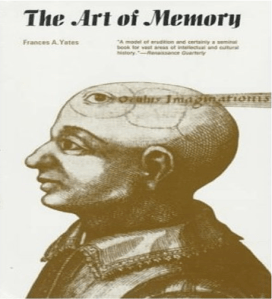 Adair’s conflation of the work of Barthes and Perec serves as an intriguing invitation to think about the concept of mythology alongside that of memory. This has been a strategy taken up by a number of historians in recent years, especially those concerned with memory’s associations with place. Prominent amongst these have been Raphael Samuel and Pierre Nora. Samuel’s ‘theatres of memory’ and Nora’s lieux de mémoire are both influenced by the work of Frances Yates, whose exploration of ‘the art of memory’ relies on notions of myth and place, yet there is an equally important role played by repetition – indeed, memory thought of as an art is born of the desire to be able to repeat. In this sense, it is interesting to note a connection between these historians and the work of the ‘memorians’ of the ‘I remember’ school. In the latter we find a recourse to a ritualistic process (anamnesis, recollection) grounded in the repeated act; this repetition is continued in the representation of memory as these writers follow the unchanging mantra of ‘I remember…’.
 One quality which fado must possess, as all guidebooks will attest, is
 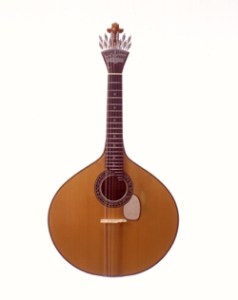 Instrumentally, fado is distinguished by the use of the guitarra portuguesa, a pear-shaped lute- or cittern-like instrument with twelve steel strings (tuned DDAABBEEAABB, from low to high, in the Lisbon style to which I mostly refer). The guitarra is played via a combination of strumming and plucking, using mostly the thumb and index finger, on which are worn unhas (‘nails’). Although in the past the guitarra had provided only harmony, by the period covered in Fado and the Place of Longing it had taken a more dominant role as provider of the melody in instrumental numbers or melodic counterpart to the voice in songs. The other constant accompaniment is provided by the viola (Spanish guitar), which provides harmony and rhythm predominantly but may occasionally lead. In addition, especially in contemporary practice, a viola baixo (acoustic bass guitar) is often added. Additional percussion is rarely used.
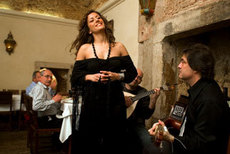 The fado singer, or fadista, tends to take the centre stage in a performance of gesture, phrasing and verbal improvisation that serves to heighten the drama of the lyric and lead the song to an appropriately momentous conclusion. Drama is often emphasized by alternating between registers and songs invariably close on a vocal climax that repeats the last part of the final verse or chorus and is punctuated by a two-chord full stop, or exclamation mark, from the guitars (generally, V–I). Lyrics are of vital importance in fado and, while some are improvised (especially in amateur settings), most are the work of fado lyricists who are not normally involved in the performing group. Adaptations of so-called ‘erudite poetry’ are common and mix with more down to earth variations of a range of lyrical themes.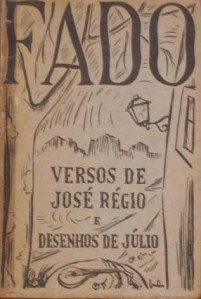


 The Place of Longing