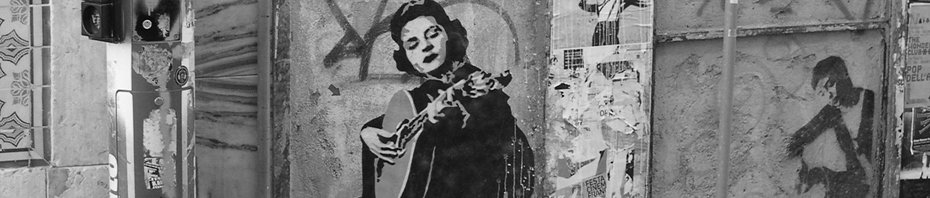
As suggested previously, the acts of carrying, bearing and bringing-to-bear are crucial to the process of witnessing. The kind of carrying I am thinking of can be heard in a fado written by Amália Rodrigues and recorded on one of her late albums. It is entitled ‘Trago Fados nos Sentidos’ [I Carry Fados in My Senses]:
Trago fados nos sentidos
Tristezas no coração
Trago os meus sonhos perdidos
Em noites de solidão.Trago versos trago sons
D’uma grande sinfonia
Tocada em todos os tons
Da tristeza e d’agonia.[I carry fados in my senses
Sadness in my heart
I bear my lost dreams
In nights of lonelinessI bear verses, I bear sounds
Of a grand symphony
Played in all the tones
From sadness to agony]
This is the form of witnessing which I believe is most important to fado, this sense of carrying and unburdening, of passing on. Interestingly, in other versions of this song such as that recorded by Cristina Branco, the word ‘fados’ is changed in the title and the verse to ‘fado’. The change is slight but helps us to make the claim for fado not only as a series of witnessed symbols but also as a process of witnessing.
The verb ‘trazer’, from which ‘trago’ comes is very popular in fado texts. It can be translated variously as ‘to bring’, ‘to wear’, ‘to bear’ and ‘to carry’. Among contemporary fado lyricists, Helder Moutinho seems particularly fond of the verb. In ‘Ai do Vento’, he sings ‘Sao as saudades que nos trazem as tristezas…’ [It’s saudades that bring us sadness]; in ‘Ao Velho Cantor’, he addresses an ‘old singer of the past’ whose eyes ‘trazem imagens de fados’ [bear images of fados]; in ‘Não Guardo Saudade a Vida’ he claims ‘Trago a saudade esquecida’ [I carry a forgotten saudade]. One of Moutinho’s albums even bears the title Que Fado É Este Que Trago? [What Fado/Fate Is This That I Bear?]. Even when this verb is not used we find many lyrics which deal with what is borne or held inside by the singer, such as the ‘fado no peito’ [fado in my breast] in Moutinho’s ‘Lisboa das Mil Janelas’.
A vital correlative, and one which connects with the sense of fate, is the sense of being carried too, as in Ana Laíns’s ‘O Fado Que Me Traga’ [The Fado/Fate That Carries Me]. A crucial metaphor in bringing together these senses of carrying and being carried is the air, and especially the wind, that carries our testimony to others and delivers theirs to us. Helder Moutinho’s ‘Fado Refugio’ speaks of carrying ‘in my voice / the life that has been offered me’ and each verse contains the line ‘Eu trago na voz o vento’ [I carry the wind in my voice]. Many fados talk about the wind and things which are carried on the wind, not only the seagulls that populate numerous songs but also the uncertainties and hopes of the future. The wind is also a force against which things are fixed, so as not to blow away or be turned: the wind of change, or of destiny. The wind is both something that carries, upon which one can be passive, and something that threatens loss: words disappear into the wind. Ana Laíns’s ‘Pouco Tempo’ is an attempt to preserve what is being lost to the wind. This is the message the written text (a poem by Lídia Oliveira) tells us and to a certain extent it is the message that the song enacts; by being a song it is a song dispersed in the air and lost. Like the poem, though, the CD on which we find Laíns’s performance tells us something else: the concept has been fixed in rhyme, set to music (‘set’ promises permanence) and recorded.
‘Ai Mouraria’, recorded by a number of fadistas, speaks of ‘Amor que o vento, como um lamento / Levou consigo / Mas que ainda agora / A toda a hora / Trago comigo’ [Love that the wind, like a lament / Carried with it / But that still now / All the time / I carry with me]. In this song, the love that the singer remembers and that disappeared with the wind, is connected to the winds of change and destiny that would affect Mouraria itself, making it both an example of the kind of mourning work described by Michael Colvin and an example of the bringing together of personal and public memories. The numerous recordings of the song by Amália at different points in her career helped to ensure that this relationship remained in people’s minds.
By the 1960s, when Amália came to record this song once more, the trope of the wind was prevalent in many popular songs. Bob Dylan used it in a number of songs that looked back to the folk, blues and country traditions of singing about travelling and being ‘in the wind’. Most famous, however, would be his use of the trope as a political metaphor in ‘Blowin’ in the Wind’. The lyric of that song finds an interesting parallel in a song entitled ‘Trova do Vento Que Passa’ [Ballad of the Wind That Passes], written by the Portuguese poet Manuel Alegre and roughly contemporaneous with Dylan’s anthem.
Alegre had been imprisoned by the PIDE, the special police force of the Estado Novo, for his political views. Following his release he spent half a year in Angola, returning to Portugal in 1963 where he wrote ‘Trova do Vento Que Passa’. The words were set to music by António Portugal and performed by Adriano Correia de Oliveira, a singer associated with the Coimbra fado. ‘Trova’ made an instant impression with listeners and became a popular staple of the student resistance against the Salazar regime much as Dylan’s ‘Blowin’ in the Wind’ would in the US Civil Rights Movement.
Adriano’s version had three verses, which describe the poet asking the wind for news of his country but hearing nothing. The second verse claims that ‘There is always someone that sows / Songs on the wind that passes’, while the third affirms that ‘Even on the saddest night / During time of servitude / There is always someone who resists / There is always someone who says no’. The verses provide a number of issues familiar to the other songs mentioned above, including the unanswering wind, a voice lost in the wind and a sense of futility. But the message changes and the crucial final lines get their full enunciatory power as the repeated words that resolve the song, becoming the ‘answer’ that had been missing. Manuel Alegre himself emphasized the importance of music in the creation of poems and poetry; music allowed the poem ‘to be a vehicle of history and memory, to sing of love or to give the signal of past or future epics, to inform and to form, to witness and to bear witness.’
Amália recorded Alegre’s poem in 1970 on Com Que Voz, her album of adaptations of great Portuguese poets, with different music composed by Alain Oulman. The version adds a verse that highlights the carrying nature of fate, describing rivers that ‘take dreams and leave sorrows’. Amália recorded two more verses of the poem, making her version more wordy than Oliveira’s. She did not, however, include the outspoken final verse and, unusually for a fado, the final lines of her version are not stressed; instead the voice disappears and the guitars bring the piece to a restrained close. It could be argued that these two versions present opposing qualities of activity and passivity. Although Amália’s version is sometimes cited as an example of her alliance with committed leftists poets, the use of different music and the removal of the ‘call to arms’ could be said to severely lessen the impact, making it a universal song about love, exile and loss as Amália was to also say of the song ‘Abandono’ which she recorded around the same time.
 Mísia, for her part, chose to revisit the song on her 2001 album Ritual, having already recorded a version for her second album in 1993. Where the
  A glance through the part of Amália’s
  It was Amália’s simultaneous ability to court these poets while remaining free from the persecutions of the Estado Novo that came to infuriate many people and that still divides opinion on the singer now. For her critics, Amália’s political naivety smacked too much of the populism peddled by Salazar himself; this was hardly helped by the fact that fado and Amália had become synonymous and that, as fado now became tarred through association with the old regime, so, many felt, should its foremost proponent. This, allied to the sheer excitement of the new forms of music springing up in the wake of the canto de intervenção movement and imported Anglo-American rock music, helped to push fado out of the spotlight in the early days of democracy. Yet fado did not go away and neither did Amália, though her career took a definite downward turn within Portugal for a few years. It was during this period that Carlos do Carmo emerged as the new lantern bearer of fado. Less politically naive than Amália, Carmo brought a commitment to the ideas of the Revolution together with love, deep knowledge and experience of fado gained from his mother, the famous fadista Lucília do Carmo, and from the fado house he inherited from his father. Carmo worked frequently with the poet José Carlos Ary dos Santos and attempted, like Rodrigues and Afonso before him, to bridge the music of the city with that of the countryside. His most notable achievements in this respect were the albums Um Homem na Cidade (1977) and Um Homem no Pais (1983), built upon Santos’s lyrics.
 When Amália did return it was in triumph, performing to packed houses and initiating a new series of recordings which, though they would often veer towards the gimmicky, nonetheless paved the way for her powerful albums of self-written material at the beginning of the 1980s. It is perhaps worth considering Geoffrey O’Brien’s discussion of the return of Burt Bacharach in the 1990s when considering both Amália’s post-Revolution comeback and her audience’s willingness to re-embrace her. The songwriting process that Bacharach and his colleagues symbolize is comparable to the creative process of fado canção, which can be seen as the driving force behind the musical period covered in Fado and the Place of Longing. Like Rodrigues’s ‘classic’ period, Bacharach’s period was one of professionals – a Hollywood-style division of labour – as opposed to the singer-songwriter style that would come to dominate afterwards; O’Brien describes the process as ‘a combination of perfectionism and commercialism’. Eduardo Sucena’s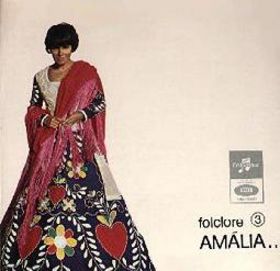
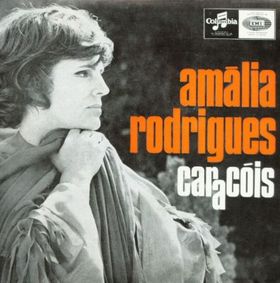
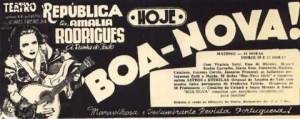 It is at this same point that fado took on the responsibility of being the professional, ‘official’ Portuguese music of loss (or, as several fadologists would seem to prefer, the music of Portuguese loss, which is saying a rather different thing). Salazar’s policies undoubtedly exacerbated this process of fencing-off but did not create it. As with the emergence of rock ’n’ roll in the United States, there are a number of issues to consider when determining why fado canção emerged when it did and why Amália Rodrigues became its paradigmatic performer, ranging from changes in the law (here, the Novo Estado policies were crucially determinant but previously extant copyright laws should not be forgotten, affecting as they do the role of the artist in the period of mass mediation); migration to the cities; changes in recording and media technology; shifts in the high/low divide in the arts.
 Her biographical details resound with references to poverty, to the Mouraria, to singing on the streets while selling fruit, to being discovered in the fado houses and wooed into the world of professional performance and recording, and, ultimately, to living her life in a fog of saudade and permanent unhappiness which no amount of success or fame could shift. The extent to which the development of this persona was deliberate or accidental seems to matter less than the place she came to occupy in the Portuguese imagination.
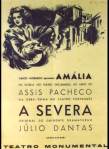 By the time Amália took on the role of Maria Severa in a 1955 Lisbon production of Júlio Dantas’s play, she had already surpassed that early fadista in terms of myth and prominence, due mainly to the success she had achieved internationally. While fado had hardly been unknown outside Portugal previously, it had never reached the level of exposure given it by Amália. Now an international star, she found herself being offered ever increasing opportunities, from performances worldwide to cinema roles nationally and in France. She had also demonstrated a strong desire to explore beyond the limits of traditional fado. It had become increasingly popular for fado singers in the 1940s to move away from the rigidly structured verses of the earlier period towards a freer style based on the work of contemporary poets such as Frederico de Brito. In addition to these newer styles of fado canção, Amália recorded other non-fado and folk songs, as well as Spanish flamenco, Mexican rancheras, and French, English and Italian versions of Portuguese songs (most famously ‘Coimbra’, released in an Italian version under the same title and refashioned as ‘Avril au Portugal’ and ‘April in Portugal’ elsewhere). This explorative aspect of Amália’s approach to her music encouraged musicians and songwriters to approach her with new ideas and led to collaborations that were to have an enormous impact on the direction fado would take.
 On the musical side it is generally agreed, and was frequently admitted by Amália herself, that it was the collaboration with the pianist and composer Alain Oulman which brought about the most far-reaching revolution in her fado style. What Oulman brought to Amália’s work was an ability to break free of established fado styles though a sophisticated musical language, while maintaining a strong link with the essential elements that kept the music recognizable as fado. Amália would rehearse with Oulman at the piano and he would occasionally accompany her on her recordings alongside the time-honoured guitarra and viola. Oulman’s arrangements allowed a greater variety of poetic styles to be utilized for fado lyrics, a development first brought to the public’s attention on the 1962 album Asas Fechadas, popularly known as Busto after the bust of Amália which adorned the cover.
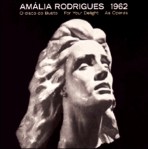 Of the nine tracks on the album seven have music written by Oulman. The lyrics are provided by Rodrigues herself (the famous ‘Estranha Forma de Vida’) and by the poets Luís de Macedo, Pedro Homem de Melo and, mostly, David Mourão-Ferreira, whose 1960 collection À Guitarra e à Viola had been dedicated to Amália and contained the verses for ‘Aves Agoirentas’ ‘Madrugada de Alfama’, ‘Maria Lisboa’ and the political fado ‘Abandono’, all included on Busto. Rodrigues and Oulman also collaborated on the work of less contemporary poets; 1965 saw the release of the EP ‘Amália Canta Camões’ and the album Fado Português, the former containing three adaptations of Portugal’s national poet, the latter harbouring one of the Camões pieces, as well as a cantiga de amigo credited to the medieval troubadour Mendinho, and the title song based on José Régio’s poem, alongside work by Mourão-Ferreira, Homem de Melo and Macedo.
 The Place of Longing