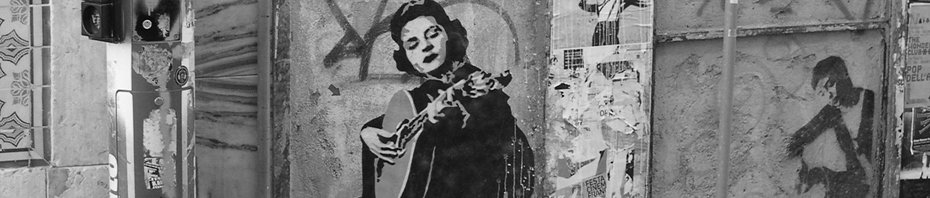
In 1976 Carlos do Carmo represented Portugal in the Eurovision song contest and recorded what would become one of his signature tunes, ‘Lisboa, Menina e Moça’, a popular song which feminizes the city as a ‘young girl’. It was his 1977 album Um Homem na Cidade [A Man in the City], however, which really showcased what Carmo meant for the future direction of fado. Described by Rui Vieira Nery as ‘one of the most significant albums in the whole fado discography’, it consisted of a series of specially written poems about Lisbon by José Carlos Ary dos Santos and set to music by a variety of composers from the worlds of Portuguese pop, jazz and fado. It was a concept album and one which clearly was aimed at the post-revolutionary metropolis, showcasing new possibilities of being in the city alongside recognition of longstanding customs that predated (and could therefore escape the taint of cooptation by) the recently overthrown dictatorship. The album came with liner notes by Carmo, Ary dos Santos and two of the composers, António Vitorino D’Almeida and Martinho D’Assunção, all of which stated a commitment to creativity, modernity, Lisbon and the people. ‘With love we leave you this disc’, wrote Carmo at the end of his note. The ‘man in the city’ is also to be found in the dedication at the beginning of Michel de Certeau’s The Practice of Everyday Life and it is interesting to consider these two works alongside each other:
To the ordinary man.
To a common hero, an ubiquitous character, walking in countless thousands on the streets. In invoking here at the outset of my narratives the absent figure who provides both their beginning and their necessity, I inquire into the desire whose impossible object he represents. What are we asking this oracle whose voice is almost indistinguishable from the rumble of history to license us, to authorize us to say, when we dedicate to him the writing that one formerly offered in praise of the gods or the inspiring muses?
(Michel de Certeau, The Practice of Everyday Life, p. v)
Certeau’s words bear an echo of the commitment shown by Henri Lefebvre to the lived experience of those connected to representational spaces. It bears a challenge to authority and the ‘view from above’, while also acknowledging the modest endeavour of a description of the everyday. So, too, with Carmo’s album, which mixes quotidian description with an imagination that recognizes the potential for transformation. Almost all of the tracks included in the album make reference to the city of Lisbon. In addition to regular references to the city as a whole, other features of Lisbon are hymned. The title track records the Tejo and the Rossio area, ‘Fado do Campo Grande’ refers to the area of the same name, and ‘O Homem das Castanhas’ uses Praça da Figueira and the Jardim da Estrela as backdrops to the chestnut vendor’s song. Two songs celebrate the public transport systems that connect Lisbon’s neighbourhoods to each other and to the world beyond. ‘O Cacilheiro’ describes the ferries that criss-cross the Tejo, connecting the quays of Cacilhas, Seixal, Montijo and Barreiro and carrying ‘lovers, sailors, soldiers and workers’ to their destinations, while the tram system is the subject of ‘O Amarelo da Carris’ (Carris is the company that operates the buses and trams in Lisbon, easily recognized by their distinctive yellow colour).
‘O Amarelo da Carris’ provides a good example in its lyrics of wider theories regarding agency, passivity, consciousness and the unconscious in the city. The first verse describes the tram which runs from runs from Alfama to Mouraria, from Baixa to Bairro Alto and ‘climbs shuddering to Graça / without knowing geography’. On one hand, the tram serves a purpose similar to the train in many popular song texts, providing a potent metaphor for the workings of fate as it faithfully follows its pre-designed course. Its passengers are passive citizens unable to alter the text of the city, etched as it is in the steel rails. Like the tram itself, which does not require knowledge of geography, the passengers can put their trust in the hands of the network and its operatives (which include, of course, the tram driver). On the other hand, they have chosen to be carried thus and are actively using the tram for their own purposes. They have a starting point and an ultimate destination; the tram and its driver are merely the means to achieve this destiny.
Similarly, the lovers described in ‘Namorados da Cidade’ are like Certeau’s ‘lovers in each other’s arms’, blind to anything beyond themselves while simultaneously creating that ‘beyond’ by going about their business. The protagonist of the title track, the man in the city, is the equivalent of the walkers found in Certeau, Aragon and Sinclair, going through the street under a ‘moon / that brings my Tejo into season / I walk through Lisbon, naked tide / that flows into Rossio’. Another song, ‘Rosa da Noite’, also hymns the incorporation of the city into the body and vice versa, claiming that ‘each street is an intense vein / where the song flows / from my huge voice’. The city is both body (a theme employed by other fados such as David Mourão-Ferreira’s ‘Maria Lisboa’) and a channel through which other bodies (human, non-human, mechanical) flow. Um Homem na Cidade celebrates all these corporeal manifestations. It is, importantly, an album, and therefore, like a photograph album, something to be taken as a whole; its songs are snapshots of the city and its citizens, a collective creating a collection, a thing. This sense of the album as a thing-in-itself was highlighted by the release, in 2004, of an album entitled Novo Homem na Cidade which recreated the original album with versions of its songs, in the same running order, recorded by twelve different artists, a number of them associated with the novo fado of the early 2000s. In addition to showcasing these younger performers, the album serves two other purposes, commemorating Carlos do Carmo’s original album as a thing-in-itself (without which the new album would not exist) and highlighting the continued relevance of the city of Lisbon as a thing-in-itself to be celebrated (without which neither album would exist).
Fado texts provide a tour of the city of Lisbon by incorporating various names associated with the city and, in Certeau’s terms, ‘liberating’ them into a new poetic and metaphoric language. Yet, given that we are dealing with a musical form, it is also necessary to remember the role played by sound in this process. If fado texts take us on a tour of the city, part of that tour involves the hearing of fado music itself. The sound of fado, its instruments and cries, are both representations of space and representational spaces, products of and responses to space itself. In Um Homem na Cidade, there are additional sounds of the city referenced, such as the sound of the tram bell emulated by the guitarra in ‘O Amarelo da Carris’ or the use of the chestnut vendor’s cry in the refrain of ‘O Homem das Castanhas’. This practice develops in sonic form a process earlier undertaken by numerous European and American modernist writers and artists to provide a representation of the noise of the city, albeit witnessed in silence (in the space of writing). For example, we find the following in Fernando Pessoa’s Book of Disquiet:
Future married couples pass by, chatting seamstresses pass by, young men in a hurry for pleasure pass by, those who have retired from everything smoke on their habitual stroll, and at one or another doorway a shopkeeper stands like an idle vagabond, hardly noticing a thing. Army recruits … slowly drift along in noisy and worse-than-noisy clusters. Occasionally someone quite ordinary goes by. Cars at that time of the day are rare, and their noise is musical. In my heart there’s a peaceful anguish, and my calm is made of resignation.
All of this passes, and none of it means anything to me. It’s all foreign to my fate, and even to fate as a whole. It’s just unconsciousness, curses of protest when chance hurls stones, echoes of unknown voices – a collective mishmash of life.
(Fernando Pessoa, Book of Disquiet, p. 14.)
This ‘collective mishmash of life’ is wonderfully transformed in ‘Fado Varina’, from Um Homem na Cidade, into a noisy and salty metaphor suggested by the cries of a woman selling fish in the market: ‘Os teus pregões / são iguais à claridade / caldeirada de canções / que se entorna na cidade’ [Your cries / are like brightness / a fish stew of songs / spilling over the city].


 the Tejo, Monsanto park, or the train lines at Alcântara, edges which help to organize space;
 Alfama, Bica, or Chiado, districts with distinguishing features;
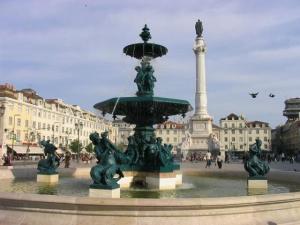 Rossio, Praça da Figueira or Martim Moniz, nodes which act as points of concentration;
 the Castelo de São Jorge, the Ponte 25 Abril or the Elevador da Santa Justa, landmarks that can be singled out.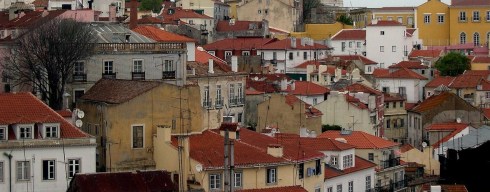
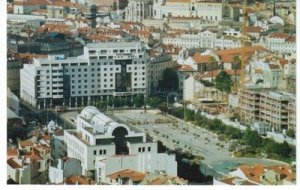
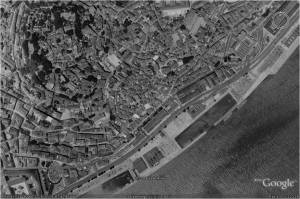
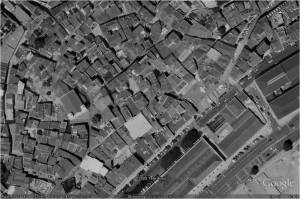
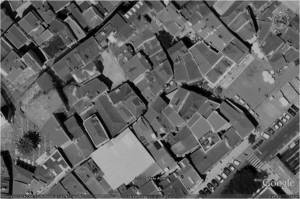
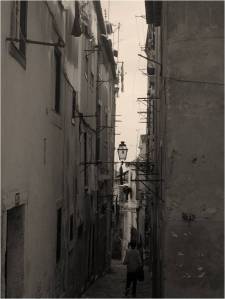


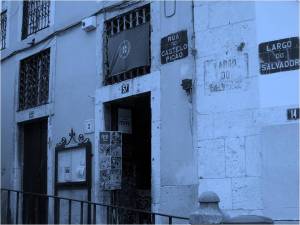

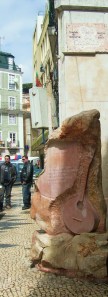 ‘É Noite na Mouraria’ [It’s Night in Mouraria], a fado performed by Amália Rodrigues and her sister Celeste, moves us toward a more particular location. Later recorded by Katia Guerreiro and Mísia, it is a typical ‘atmosphere’ song, listing a number of the mythemes we have come to expect from a fado narrative: the low sound of a guitarra, a fado being sung in a dark alleyway, the whistle of a boat on the Tejo, a passing ruffian. This fado works as a companion piece to the classic song of fado’s ontology, ‘Tudo Isto É Fado’; the delivery is not dissimilar, comparable mythemes are present, and there is a declaration in the song that ‘all is fado / all is life’. Mouraria is also represented in fados that mention the Rua da Capelão, linked forever to the name of Maria Severa and to the birth of modern fado. The most famous, ‘Rua do Capelão’ (with words by Júlio Dantas and music by Frederico de Freitas), places the street at the centre of the Severa story. The site of Severa’s house is now commemorated in a very Portuguese fashion, having its own dedicated pattern in the calçada, the white and black cobbled pavements found throughout Lisbon. At the entrance to the street there is also a monument to mark its place in history, consisting of a sculpture of a guitarra with the words ‘Birthplace of fado’ beside it. In this way, fado does not only reflect the city’s presence, but asserts its own presence in the city. One can, if one desires, use the Rua do Capelão as the start of a walking tour of the city solely based on fadistic associations, from the labyrinth of Mouraria’s streets up the slopes surrounding the Castelo de São Jorge to the neighbourhoods of Alfama, Graça and Madragoa.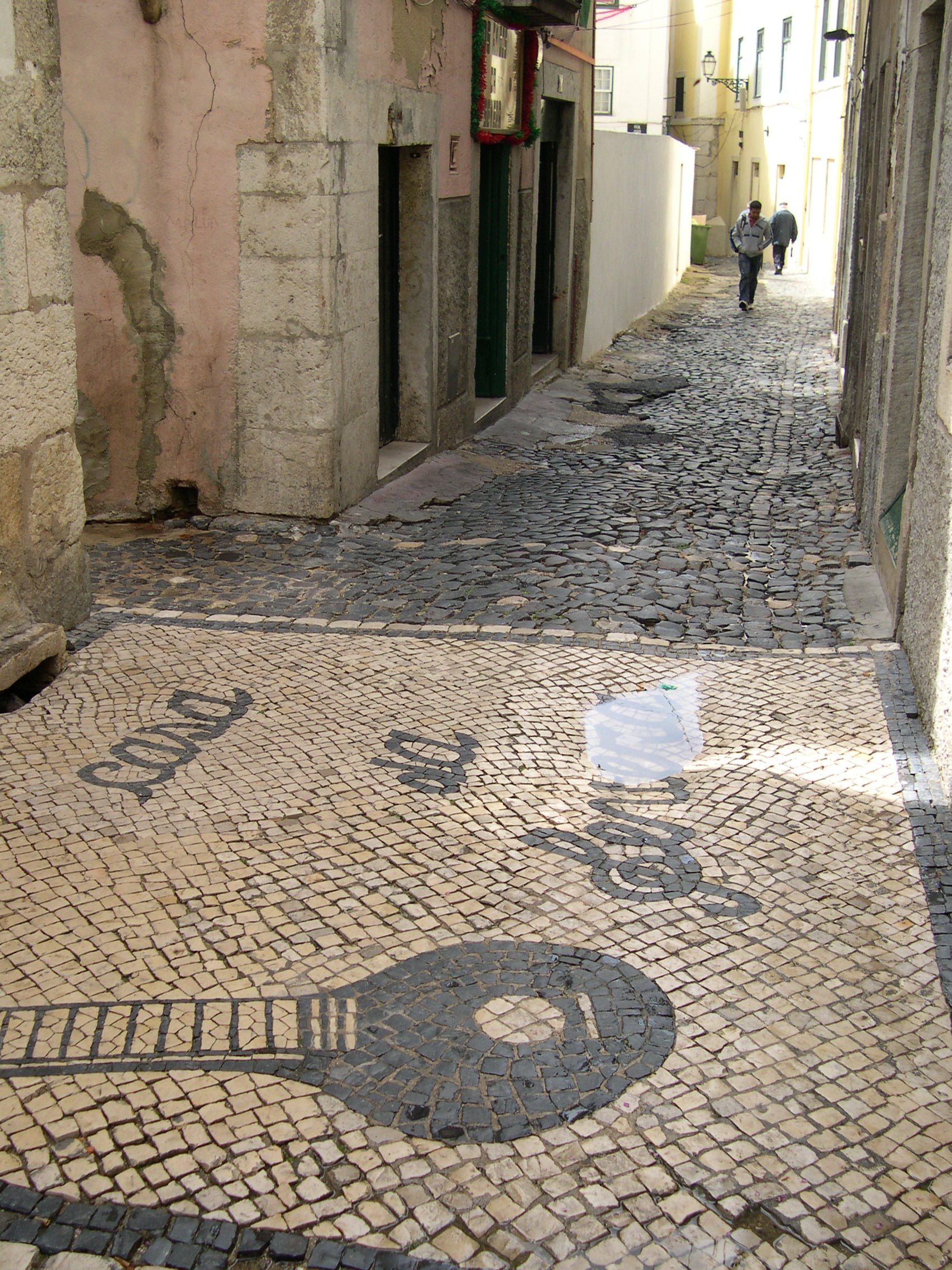

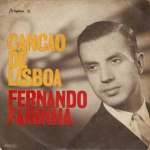 We might say, then, that the discourse surrounding Marceneiro and Farinha is one rich with ‘authenticity work’. This work is done through ceaseless reminders of the connection between the performer and the neighbourhood/city; Farinha is ‘do povo’ but also ‘da Bica’, ‘de Lisboa’ and, ultimately, ‘do fado’. From this position he could then make claims to the city and its music, as he did throughout his career. Marceneiro was a similarly ‘ordained’ commentator on the city, as can be heard on his version of Carlos Conde’s ‘Bairros de Lisboa’, where the city’s presence is introduced by the framing device of a walk through its streets. The verses, sung as a duet with Fernanda Maria, present a sort of competition between various neighbourhoods as to which is most relevant to fado: Campo de Ourique is the most elevated, Alfama is the most famous, the most fadista and maritime, Mouraria evokes the most nostalgia, Bairro Alto is praised for its inhabitants, Madragoa for its youthful optimism. In the end, there is a realization that the city should not be reduced to its parts: ‘Why go any further / If Lisbon is all beautiful / And Lisbon is our neighbourhood!’
 The Place of Longing