
Here the sea ends and the earth begins. It is raining over the colorless city. The waters of the river are polluted with mud, the riverbanks flooded. A dark vessel, the Highland Brigade, ascends the somber river and is about to anchor at the quay of Alcântara. The steamer is English and belongs to the Royal Mail Line. She crosses the Atlantic between London and Buenos Aires like a weaving shuttle on the highways of the sea, backward and forward, always calling at the same ports, La Plata, Montevideo, Santos, Rio de Janeiro, Pernambuco, Las Palmas, in this order or vice versa, and unless she is shipwrecked, the steamer will also call at Vigo and Boulogne-sur-Mer before finally entering the Thames just as she is now entering the Tagus, and one does not ask which is the greater river, which the greater town.
(José Saramago, The Year of the Death of Ricardo Reis, tr. Giovanni Pontiero (London: Harvill, 1992 [1984]), p. 1.)
So begins The Year of the Death of Ricardo Reis, the classic novel by José Saramago, the Portuguese writer who died today at the age of 87. The combination of the potentially fantastic and the banal, the metaphoric and the everyday, is typical of Saramago. There is always a sense in his prose that, whatever the story he might be telling us, there are a multitude of stories framing it, running alongside it or visible just beyond its borders. Saramago wants us to know that those stories, which are sometimes really observations (as all stories are observations, ways of seeing the world) and sometimes fantastical retellings of official history, need to be included in the story he is telling us, such that we imagine, or he lets us believe we imagine, that what is unfolding in the labyrinth of his text is one, unending metastory. Frequently, in his wandering, loosely punctuated prose–sometimes described as magical realism, sometimes as stream-of-consciousness, but perhaps just as easily though of as the flow of history running all around us and threatening to drown us in the present–he will take us sidestepping through the fragile walls that separate these universes, giving us a glimpse of the bigger picture before shuttling us back to the scene in which this particular story is taking place.
One does not ask which is the greater river, which the greater town. In The Year of the Death of Ricardo Reis, we know which town we have settled in. The novel tells the story of the dead writer Fernando Pessoa returning to visit one of his surviving heteronyms, the classically minded poet Ricardo Reis. In fact Pessoa is not quite dead, but rather existing in the exile of limbo while he awaits a more permanent death. Reis, too, is an exile, returning to Lisbon in the opening scene of the book after a period in Brazil. Over the course of the book, Reis is constantly witnessed wandering the streets of Lisbon in a recurrent pattern that, spelled out on the sidewalks and in Saramago’s wandering prose, symbolizes his brief presence in the city as a kind of psychogeographer. Like Paul Auster’s New York Trilogy, Michel de Certeau’s The Practice of Everyday Life and Iain Sinclair’s Lights Out For The Territory, the citizen as walker is both reader and writer, at once subject to the pre-existing paths laid out in the city text and yet able to assert an agency via the sheer act of activity. But Ricardo Reis is not long for this world–he can not be seen, in however magical a reality, to exist beyond the fading memory of his recently deceased creator, Pessoa–and he always seems to be at the mercy of what Italo Calvino calls the ‘intuition of the city as language, as ideology, as the conditioning factor of every thought and word and gesture … as monstrous as a giant crustacean, whose inhabitants are no more than motor articulations’.
Here is Saramago’s description of one of Ricardo Reis’s strolls:
Ricardo Reis walks up the Rua do Alecrim, and no sooner has he left the hotel than he is stopped in his tracks by a relic of another age, perhaps a Corinthian capital, a votive altar, or funereal headstone, what an idea. Such things, if they still exist in Lisbon, are hidden under the soil that was moved when the ground was leveled, or by other natural causes. This is only a rectangular slab of stone embedded in a low wall facing the Rua Nova do Carvalho and bearing the following inscription in ornamental lettering, Eye Clinic and Surgery, and somwhat more austerely, Founded by A. Mascaró in 1870. Stones have a long life. We do not witness their birth, nor will we see their death. So many years have passed over this stone, so many more have yet to pass, Mascaró died and his clinic was closed down, perhaps descendants of the founder can still be traced, they pursuing other professions, ignoring or unaware that their family emblem is on display in this public place. If only families were not so fickle, then this one would gather here to honor the memory of their ancestor, the healer of eyes and other disorders. Truly it is not enough to engrave a name on a stone. The stone remains, gentlemen, safe and sound, but the name, unless people come to read it every day, fades, is forgotten, ceases to exist. These contradictions walk through the mind of Ricardo Reis as he walks up the Rua do Alecrim…
(pp. 46-7)
Poetry, fantasy, the monumental and the everyday, the eternal and the transient, memory, loss, pathos, and the humour of pessimism: all this exists in Saramago’s late voice. He will be missed.

 the Tejo, Monsanto park, or the train lines at Alcântara, edges which help to organize space;
 Alfama, Bica, or Chiado, districts with distinguishing features;
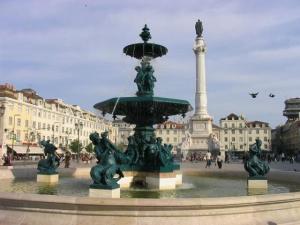 Rossio, Praça da Figueira or Martim Moniz, nodes which act as points of concentration;
 the Castelo de São Jorge, the Ponte 25 Abril or the Elevador da Santa Justa, landmarks that can be singled out.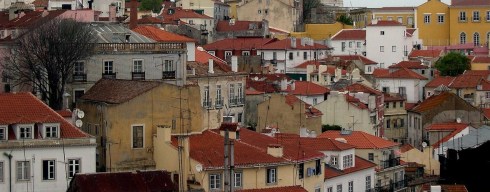
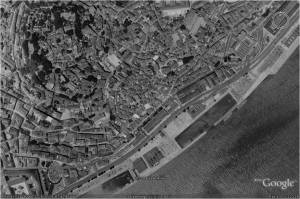
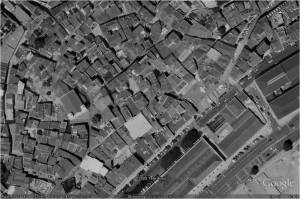
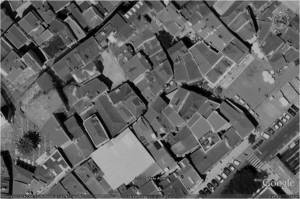
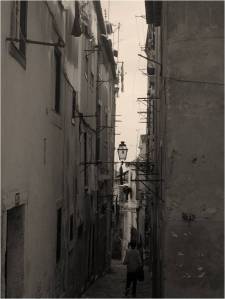


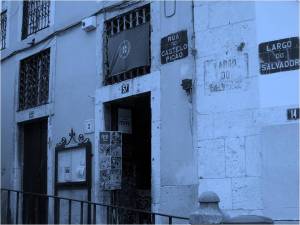

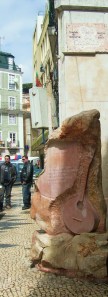 ‘É Noite na Mouraria’ [It’s Night in Mouraria], a fado performed by Amália Rodrigues and her sister Celeste, moves us toward a more particular location. Later recorded by Katia Guerreiro and Mísia, it is a typical ‘atmosphere’ song, listing a number of the mythemes we have come to expect from a fado narrative: the low sound of a guitarra, a fado being sung in a dark alleyway, the whistle of a boat on the Tejo, a passing ruffian. This fado works as a companion piece to the classic song of fado’s ontology, ‘Tudo Isto É Fado’; the delivery is not dissimilar, comparable mythemes are present, and there is a declaration in the song that ‘all is fado / all is life’. Mouraria is also represented in fados that mention the Rua da Capelão, linked forever to the name of Maria Severa and to the birth of modern fado. The most famous, ‘Rua do Capelão’ (with words by Júlio Dantas and music by Frederico de Freitas), places the street at the centre of the Severa story. The site of Severa’s house is now commemorated in a very Portuguese fashion, having its own dedicated pattern in the calçada, the white and black cobbled pavements found throughout Lisbon. At the entrance to the street there is also a monument to mark its place in history, consisting of a sculpture of a guitarra with the words ‘Birthplace of fado’ beside it. In this way, fado does not only reflect the city’s presence, but asserts its own presence in the city. One can, if one desires, use the Rua do Capelão as the start of a walking tour of the city solely based on fadistic associations, from the labyrinth of Mouraria’s streets up the slopes surrounding the Castelo de São Jorge to the neighbourhoods of Alfama, Graça and Madragoa.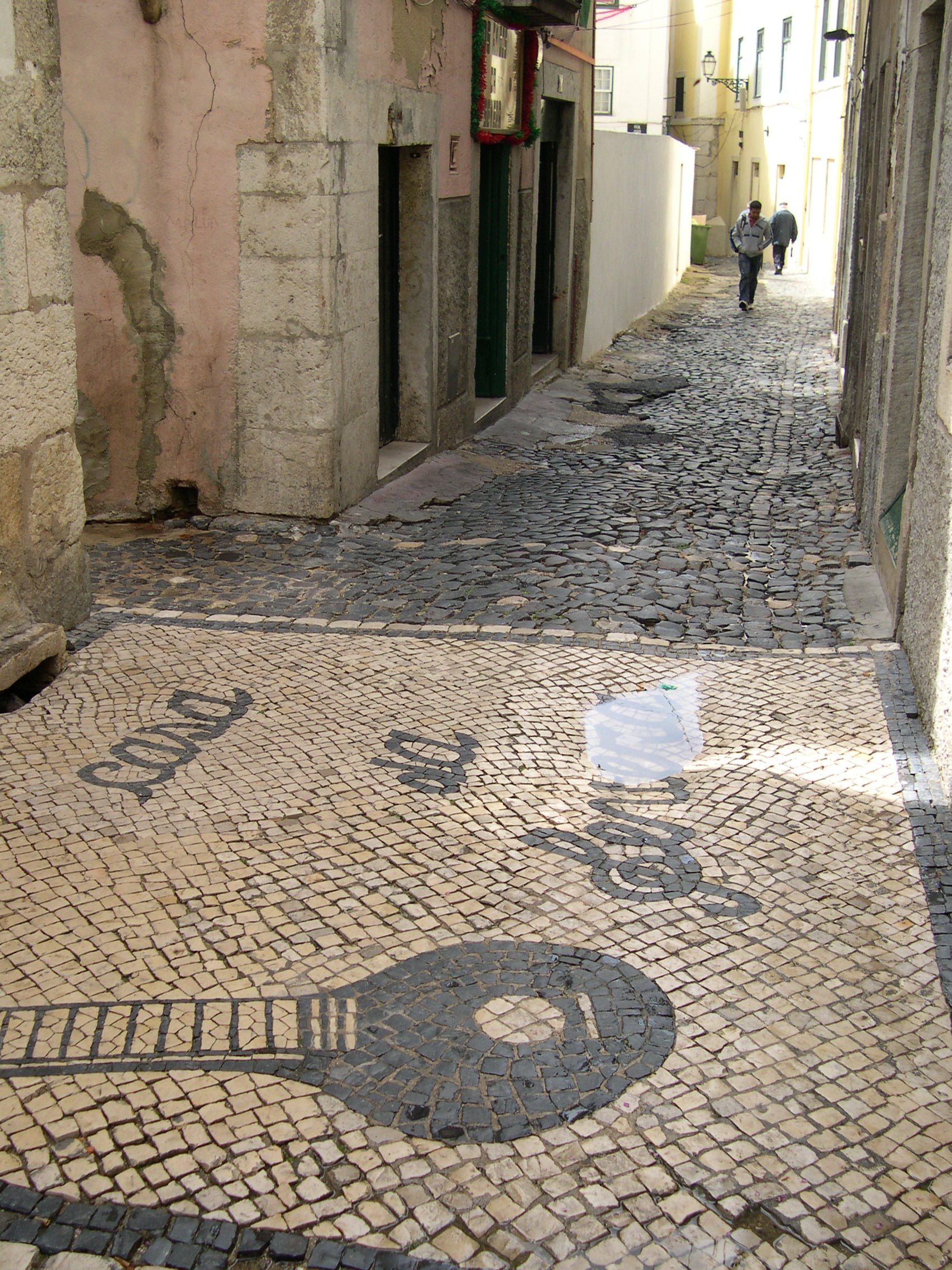

 We might say, then, that the discourse surrounding Marceneiro and Farinha is one rich with ‘authenticity work’. This work is done through ceaseless reminders of the connection between the performer and the neighbourhood/city; Farinha is ‘do povo’ but also ‘da Bica’, ‘de Lisboa’ and, ultimately, ‘do fado’. From this position he could then make claims to the city and its music, as he did throughout his career. Marceneiro was a similarly ‘ordained’ commentator on the city, as can be heard on his version of Carlos Conde’s ‘Bairros de Lisboa’, where the city’s presence is introduced by the framing device of a walk through its streets. The verses, sung as a duet with Fernanda Maria, present a sort of competition between various neighbourhoods as to which is most relevant to fado: Campo de Ourique is the most elevated, Alfama is the most famous, the most fadista and maritime, Mouraria evokes the most nostalgia, Bairro Alto is praised for its inhabitants, Madragoa for its youthful optimism. In the end, there is a realization that the city should not be reduced to its parts: ‘Why go any further / If Lisbon is all beautiful / And Lisbon is our neighbourhood!’
 The Place of Longing